By the late 1990s, security printing firms were under siege by counterfeiters with advanced and affordable digital reproduction devices. It was a new counterfeiting climate, demanding new tools. So, the Bank of Canada adopted a new design strategy in 2002, and the Canadian Journey series became the first Canadian notes designed wholly on computers. One person executed the overall designs: Canadian Bank Note Company art director Jorge Peral. This could only be accomplished with the computer’s ability to provide multiple versions of a design quickly and easily.
It was also the first series to involve Canadian citizens in the choice of note themes. The Bank convened many focus groups to decide what values or achievements most reflected the Canadian experience. And these elements—from the arts to winter fun to women’s suffrage—adorned the backs of the notes. At the time, it was considered to be the most Canadian of our note series.
Engraving and intaglio printing were still important aspects of this series. They give bank notes their traditional look and feel. However, the main counterfeit defenses were no longer in the intricacy or perfection of the engraving but in applied features such as metal threads, holograms, ghost images, puzzle numbers, shifting colour metallic stripes and hidden aspects only detectable under ultraviolet light.
Features also included tactile details designed to make the notes easily distinguishable by the visually impaired. A series of braille-like raised dots along the top right edge identified each denomination. These are very difficult to forge, adding yet another counterfeiting stumbling block.
Security
How to check notes
Canadian Journey notes (2004–2006)
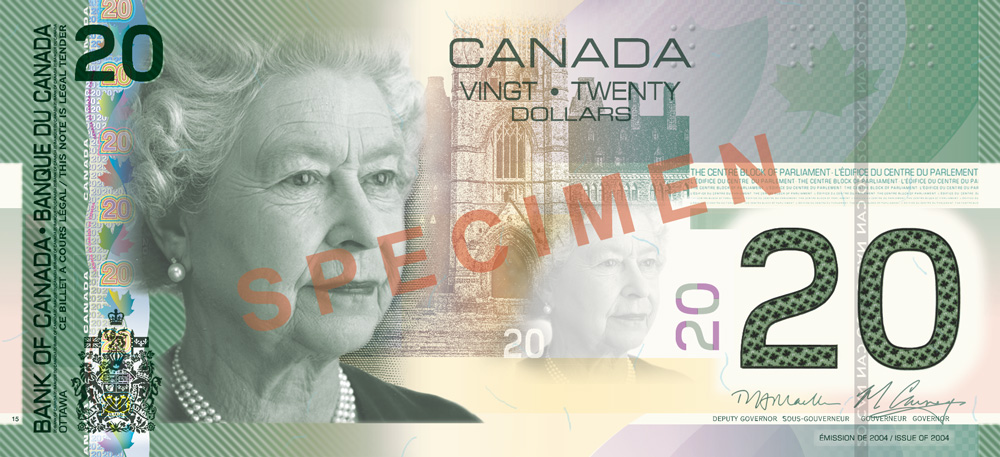
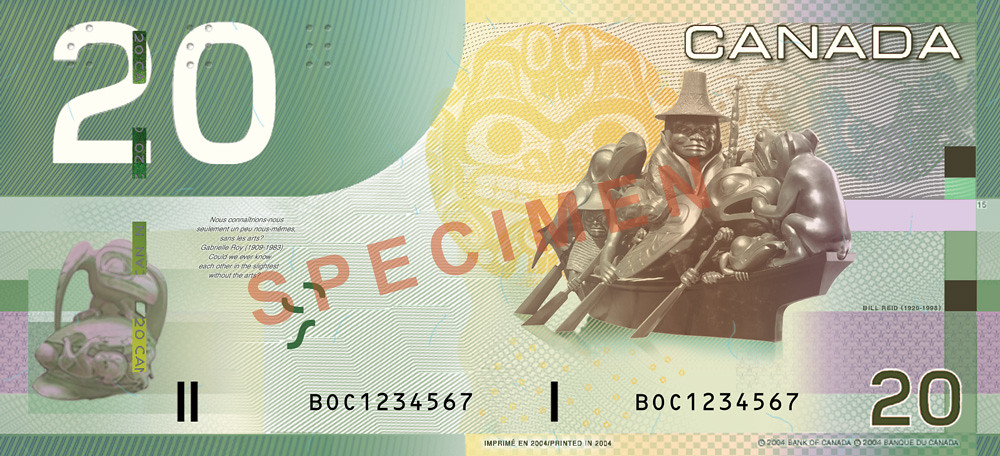
Checking security features on bank notes is simple to do. But if you have doubts when verifying any note, ask for another one.
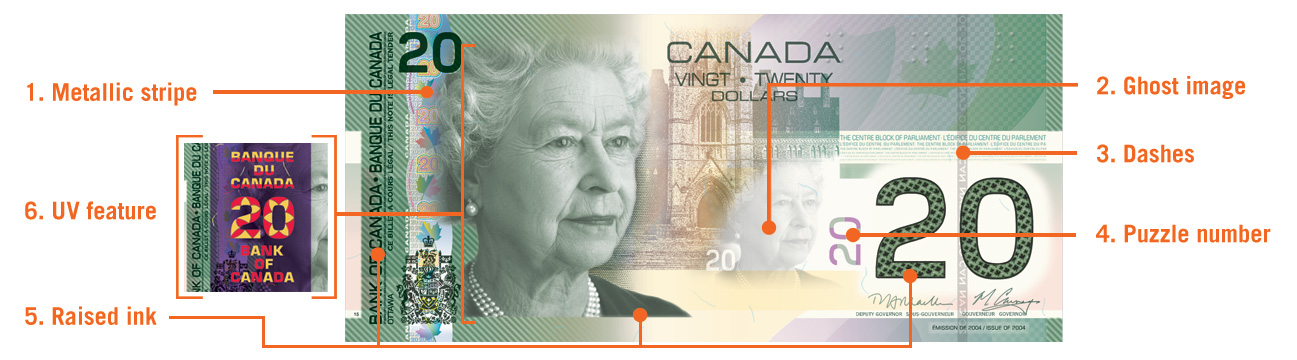
The Canadian Journey $20, $50 and $100 notes were introduced in 2004, and the $5 and $10 notes were upgraded in 2005–2006 so that the same suite of security features appears on all five denominations.
1. Metallic stripe
Tilt the note. The numbers and maple leaves change colour.
2. Ghost image
Hold the note up to the light and look through it. A small, ghost-like image of the portrait appears. It is visible from both sides of the note.
3. Dashes
Hold the note up to the light and look through it. The dashes form a solid line. It is visible from both sides of the note.
Tilt the note. The dashes shift from gold to green. Small characters (e.g., CAN 20) match the note’s value.
4. Puzzle number
Hold the note up to the light and look through it. Irregular marks on the front and back of the note form a complete number. It is visible from both sides of the note.
5. Raised ink
Feel the raised ink on the shoulders of the portrait, the large number, and the words “Bank of Canada • Banque du Canada.”
6. UV feature
Look at the note under UV (ultraviolet) light. Check that the text BANK OF CANADA – BANQUE DU CANADA and a number matching the note’s value glow in interlocking red and yellow. Red and yellow fibres are scattered on both sides of the note.
Tip
Don’t rely solely on this feature. Always look at two or more features when checking notes.
Original Canadian Journey $5 and $10 notes (2001–2002)
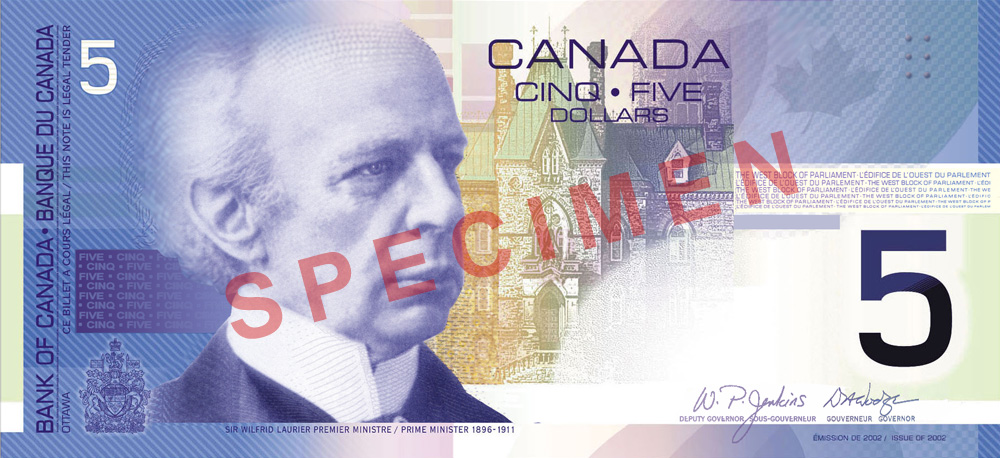
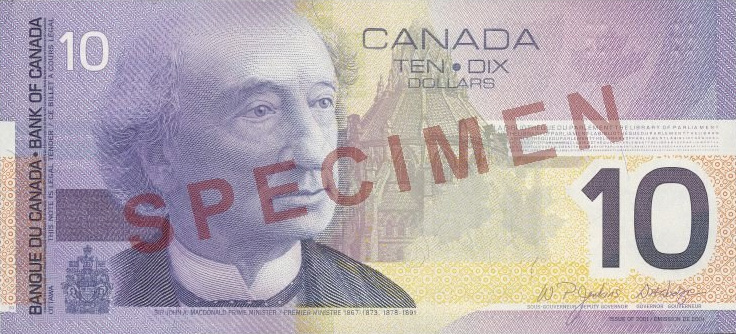
The original $5 and $10 notes of the Canadian Journey series (2001-2002) had different security features that did not include a metallic stripe, ghost image, dashes, or a puzzle number.

1. Maple leaves
Tilt the note. Three maple leaves shift from pale to shiny gold.
2. Hidden number
Slightly tilt the note at eye level. The number 5 or 10 appears.
3. Raised ink
Feel the raised ink on the shoulders of the portrait, the large number 5 or 10, and the words “Bank of Canada • Banque du Canada.”
4. UV feature
Look at the note under UV (ultraviolet) light. The coat of arms and the words FIVE ● CINQ (or DIX ● TEN) and BANK OF CANADA – BANQUE DU CANADA glow in blue over the portrait. Red fibres are scattered on both sides of the note.
Tip
Don’t rely solely on this feature. Always look at two or more features when checking notes.
Explore each note
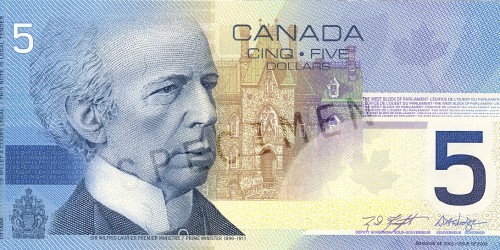
Canadian Journey Series $5 Note
The $5 note, issued in March 2002, was the second in the series. The face features a portrait of Sir Wilfrid Laurier produced by the noted Swedish engraver Czeslaw Slania and a vignette of the West Block of the Parliament Buildings.
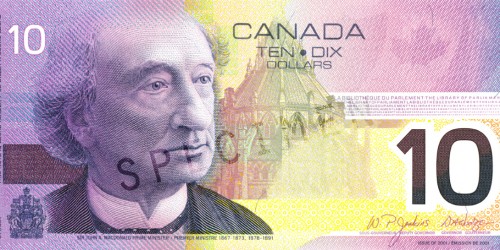
Canadian Journey Series $10 Note
The face of the $10 note features a portrait of Sir John A. Macdonald engraved by Jorge Peral and a vignette of the Library of Parliament.
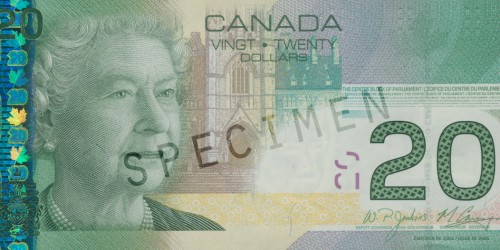
Canadian Journey Series $20 Note
The $20 note, issued in September 2004, features a portrait of the Queen based on a photograph taken in 2000 by Charles Green specifically for this note.
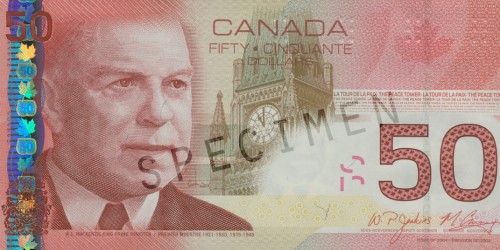
Canadian Journey Series $50 Note
Issued in November 2004, the $50 note features a portrait of Prime Minister Mackenzie King produced in Germany by Giesecke & Devrient (a security printer with subsidiaries around the world and parent company of BA International Inc.) using a computer-assisted engraving process.
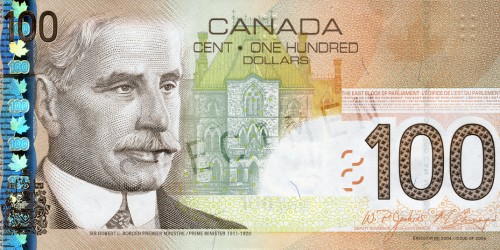
Canadian Journey Series $100 Note
The portrait of Sir Robert Borden on the $100 note was engraved by Czeslaw Slania, based on a watercolour (above) by Jorge Peral.