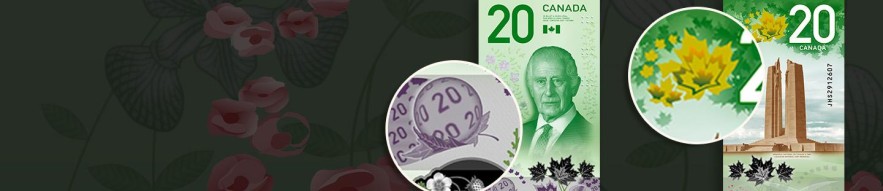
Build real world skills to detect counterfeit bank notes by examining Canadian bank notes and learning to recognize their security features.
You can save a copy of this webpage by using the Print: Save as PDF feature of your browser.
Overview
This lesson includes several skills-based activities. If all activities are completed, students will get a certificate of completion at the end. For best results, follow the activities in order.
Activity 1: Learn about legal tender and the importance of bank notes as a method of payment.
Activity 2: Explore and identify security features on Canadian bank notes with the help of dynamic videos.
Activity 3: What would you do if you spotted a counterfeit bank note? Role play different scenarios and learn how to handle these situations.
Activity 4: Review what’s been learned and play bingo.
Conclusion: Students will earn a certificate of completion.
Big idea
Canadian bank notes are easy to check and hard to counterfeit. Knowing how to spot counterfeit bank notes is an important skill in daily life and in the workplace.
Total time
Approximately 150 minutes or 2 periods
Grade levels
Grades 9 to 11; Secondary 3 to 5
Subject areas
Economics
- Currency and economic stability
- Government roles in the economy
- Intrinsic value, gold standard and fiat money
Business and careers
- Employability skills
- Ethical, moral and legal considerations in business
- Customer service skills and communication skills
- Fraud prevention and counterfeit detection
Learning objectives
Students will:
- develop workplace skills in handling cash that can prevent bank note fraud
- use literacy, narrative structure and storytelling to improve memory retention
- identify how advancing technology has led to improved bank note security and protection against counterfeiting
- identify security features on the most recent Canadian bank notes
- define legal tender, counterfeiting and security features
- identify strategies to safely refuse counterfeit notes
Materials
Classroom supplies and technology
- a Frontiers series bank note – or use an image from our website
- a Vertical series $10 bank note – or use an image from our website
- an image of the Vertical series $20 bank note
- printer and paper
- pens or pencils, erasers and paper for notes
- projector or display screen connected to a computer
- bingo chips, markers, daubers or pens
- blank cue cards, sticky notes, card stock or paper in palm-sized pieces
Worksheets
- Download all of the worksheets.
- Print the resources in the quantities indicated. To save on paper printing, these resources can be distributed digitally or displayed for the class. All student worksheets are fillable PDFs.
- Activity 2: “Security feature worksheet” (one copy per student), “Bank notes: it pays to check” (distribute digitally)
- Activity 3: “Vertical 10 security leaflet” (distribute digitally) “Vertical 20 bank note leaflet” (distribute digitally)
- Activity 4: “Bingo card” (one copy per student)
- Conclusion: “Certificate of completion” (one copy per student)
Activity 1: Understanding legal tender
An introduction to the purpose and function of bank notes and legal tender.
Time
15 minutes
1.1 Introduction
Ask your students:
- How often do you use bank notes? What about other family members or friends? Have you ever received cash as a gift or payment for a job?
- As of 2026, bank notes are used in 1 out of every 5 in-person transactions.
- Bank notes are most often used for smaller value purchases, an area that students are likely to encounter in part-time jobs in retail, food services and more.
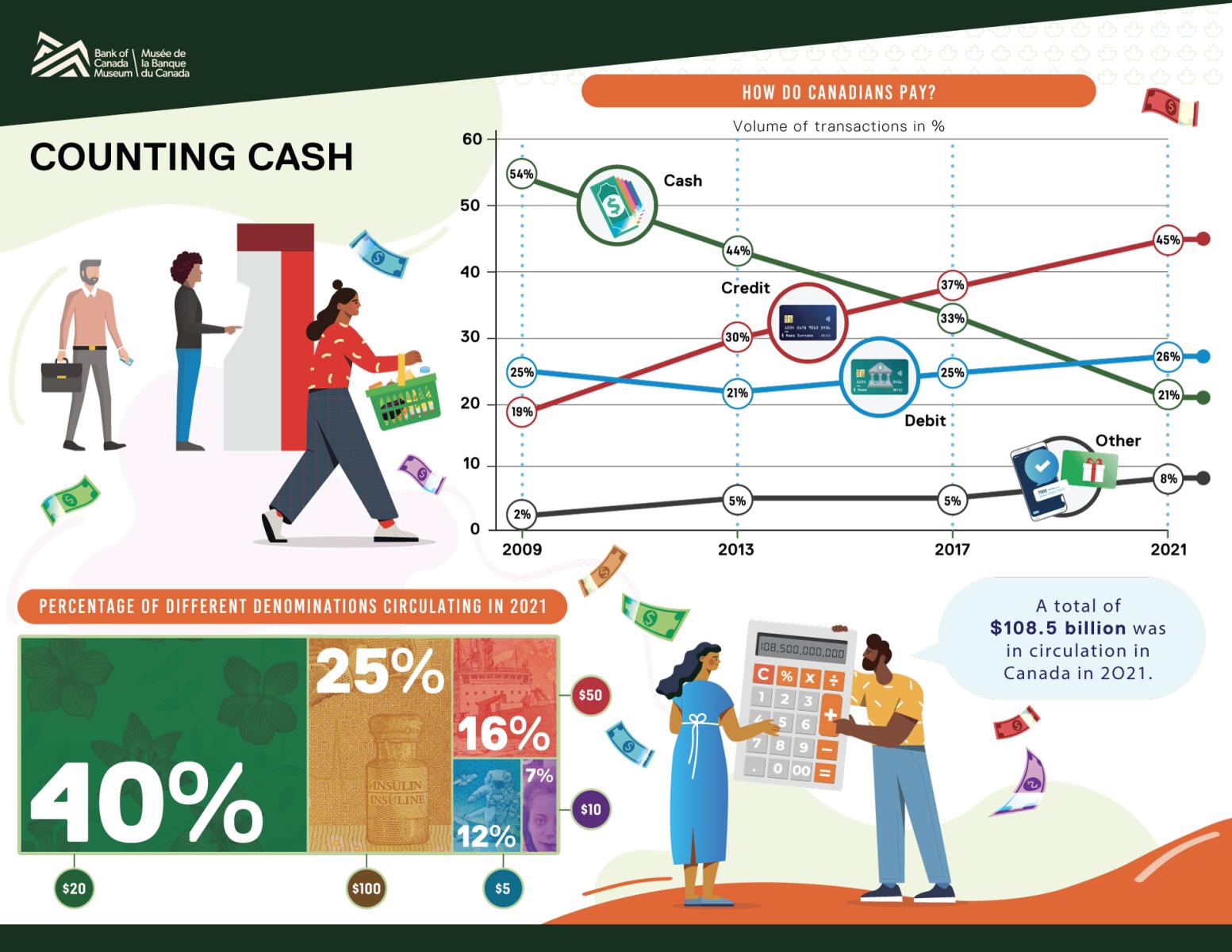
An infographic on cash use in Canada.
1.2 Denominations and legal tender
Ask your students:
- Have the denominations of Canadian bank notes always been the same?
- The denomination is how much a bank note is worth.
- Canada used to have $1 and $2 bank notes instead of coins.
- Canada used to have a $1000 bank notes. There have also been $25 and $500 bank notes in the past.
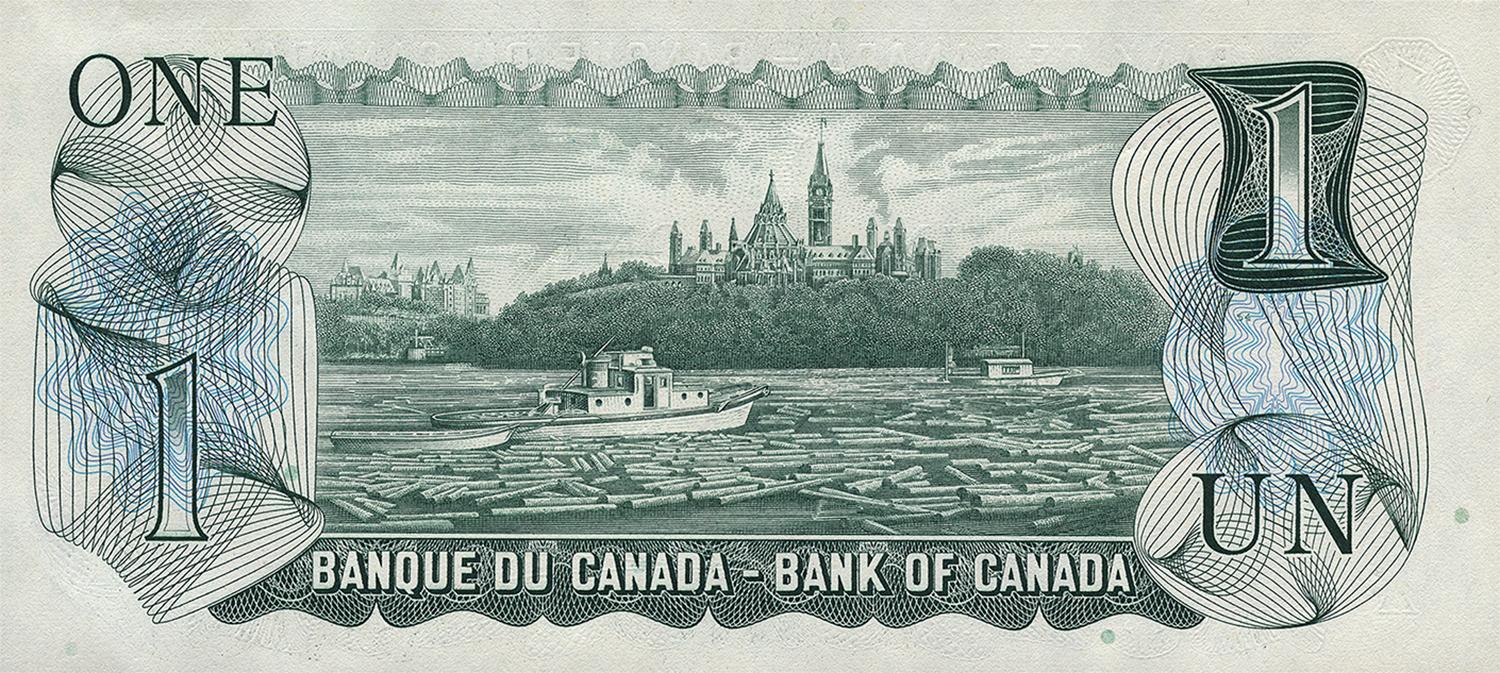
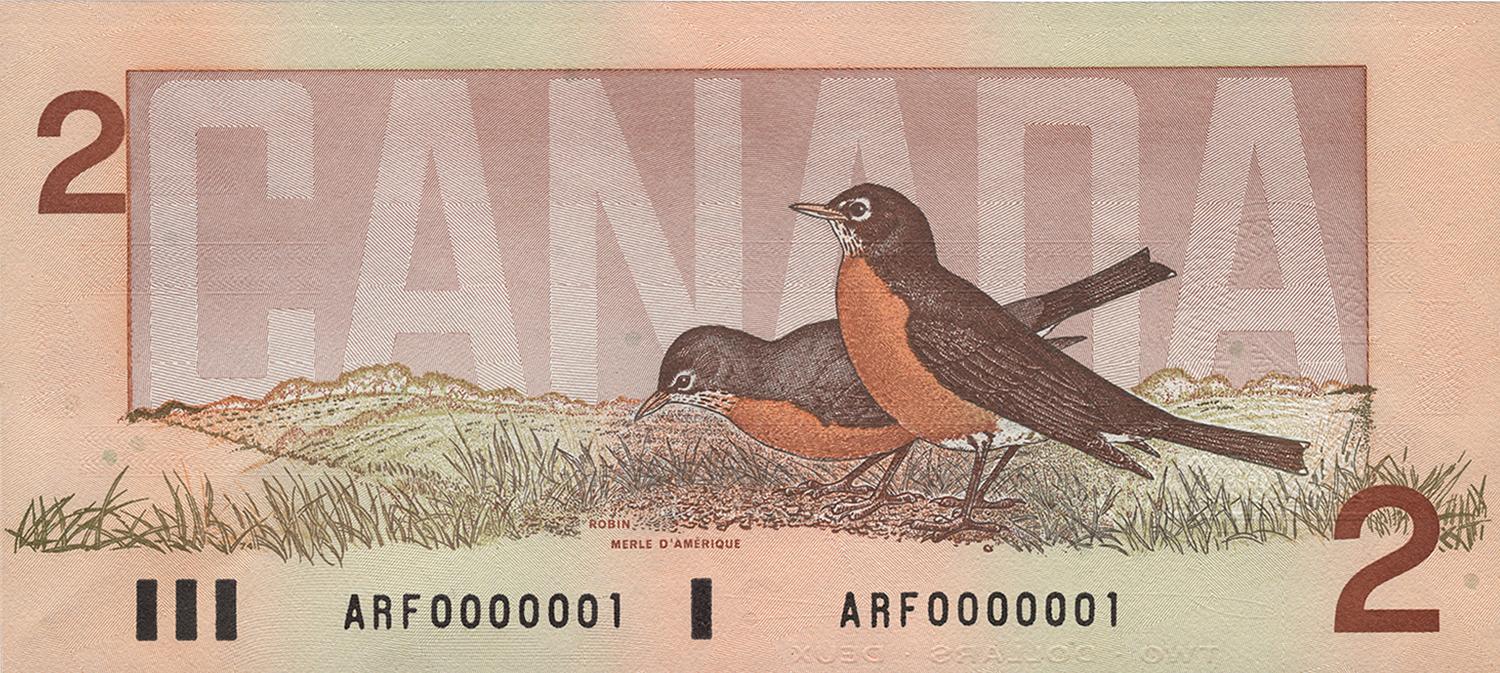
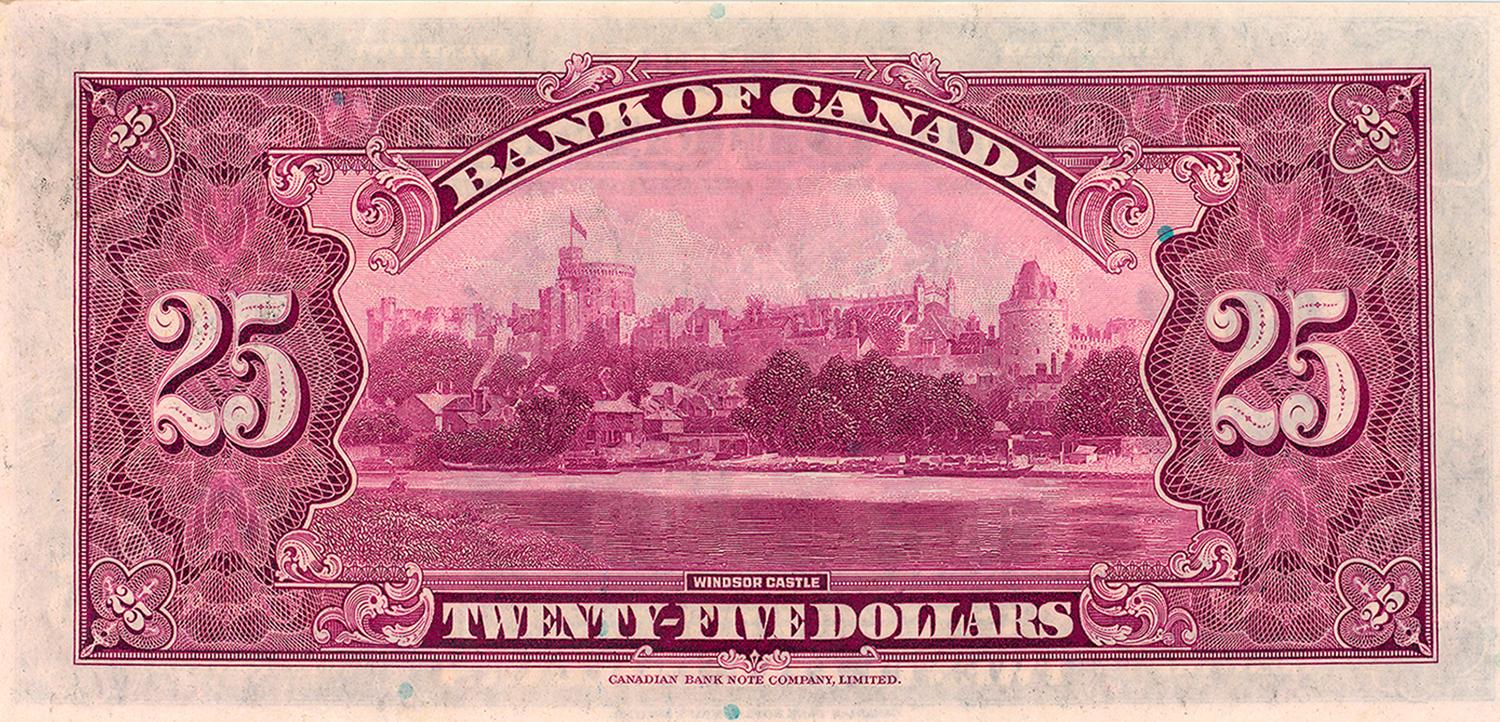
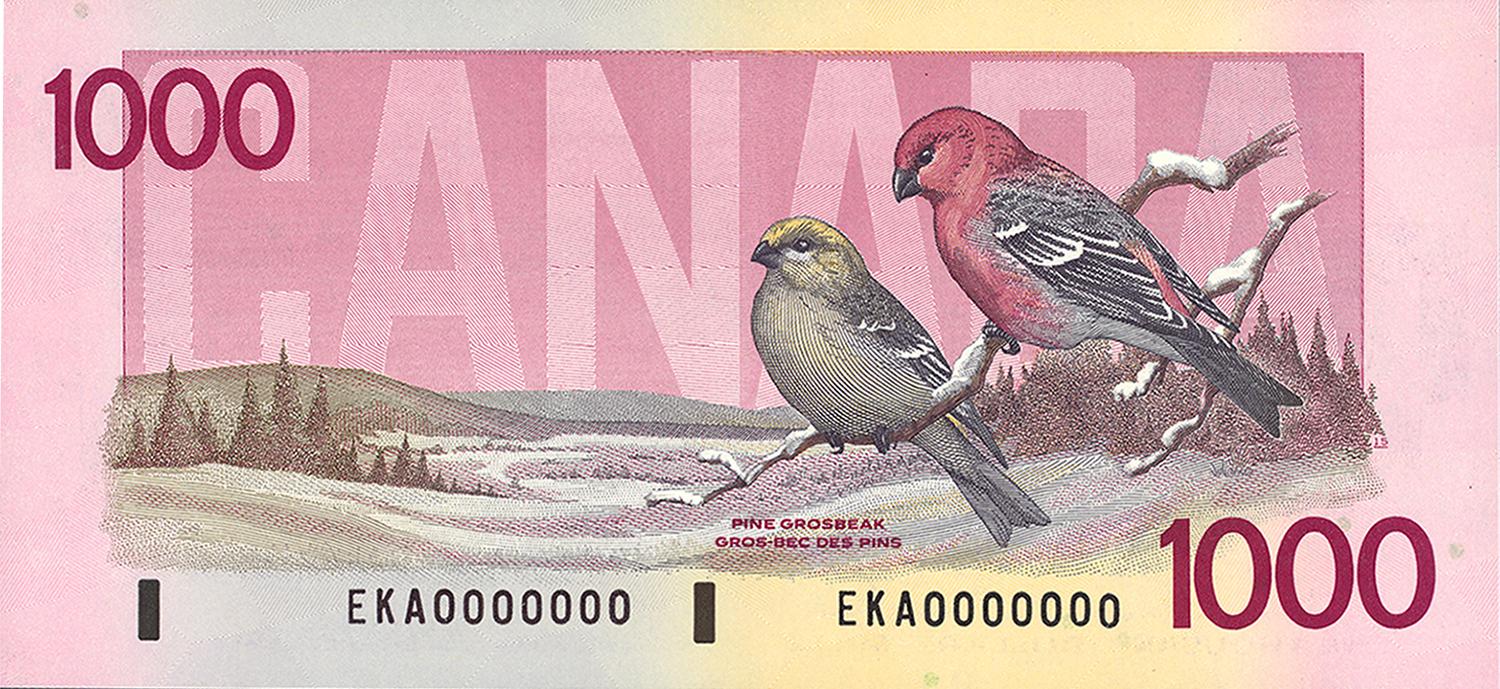
Canada used to have a $1, $2, $25 and $1000 bank notes
Sources: 1 dollar, Canada, 1973 | 1983.33.10; 2 dollars, Canada, 1986 | 2000.49.1; 25 dollars, Canada, 1935 | 1984.23.29; 500 dollars, Canada, 1935 | 1992.37.184; 1000 dollars, Canada, 1988 | 2000.25.2
Explain that bank notes issued by the Bank of Canada, together with coins issued by the Royal Canadian Mint, are what is known as legal tender. That’s a technical term meaning the Government of Canada has deemed them to be the official money we use in our country. It does not mean that a business has to accept them. A merchant has the right to decide what kind of payment they accept, whether that is cash, debit, credit, digital payments or anything else.
Learn more about legal tender and whether merchants have to accept cash. Spoiler: They don’t.
Bank notes are issued in series (sets) that circulate at around the same time. When a new series is released, the old ones are taken out of circulation slowly as they become worn or damaged. But all the notes issued by the Bank of Canada are still legal tender, apart from a few exceptions.
In 2021, the $1, $2, $25, $500 and $1000 bills from every Bank of Canada series were removed as legal tender and cannot be spent in a cash transaction.
For more on legal tender, visit the Bank’s page About legal tender.
But what about the rest of the old bills? Will you ever see a 1935 series $20 bank note working at a cash register? It’s unlikely, but it’s not impossible. Over 90% of bank notes in circulation are polymer notes but many older series paper notes still exist in private collections and are still legal tender. They are, however, withdrawn from circulation, which means that when they find their way to commercial banks, those banks will return them to the Bank of Canada to be shredded and disposed of. This helps keep easier-to-counterfeit notes out of circulation so that most people will be using the newest and most secure notes.
Activity 2: Discovering the security features of bank notes
Counterfeiting costs businesses money and undermines Canadians’ trust in our currency. Canada’s bank notes have a series of robust security features that are difficult to counterfeit and easy to verify, but they only work if bank notes are checked by someone who knows what to look for.
Time
60 minutes
2.1 Counterfeiting
Explain to your students:
- In order to be useful, bank notes need to be trusted. To be trusted, they need to be secure.
- Criminals have been attempting to get something for nothing by creating counterfeit bank notes for as long as there has been money.
- Canada’s Criminal Code defines a counterfeit as a false coin or paper money that resembles or is apparently intended to resemble or pass for a current coin or current paper money, a forged bank note or forged blank bank note, whether complete or incomplete or a genuine coin or genuine paper money that is prepared or altered to resemble or pass for a current coin or current paper money of a higher denomination.
- Although the law specifically mentions paper, it also applies to our polymer notes.
- Creating, passing or possessing counterfeit money, whether bank notes or coins, is an indictable offence under section 449 and section 450 of the Criminal Code of Canada and can land you in jail for up to 14 years.
- Counterfeits that have been accepted must be turned over to police and you will not be reimbursed. Anyone, an individual or a business, will lose the value of those bank notes because counterfeits are worthless. This is why it’s important to take the time to check the notes you receive.
Check out the Bank’s interactive statistical graphs on counterfeiting. Back in 2004, before the introduction of our polymer bank notes, over half a million counterfeit bank notes were found circulating in the Canadian economy. That number dropped with the arrival of the Frontiers series and was down to just over 22,000 notes at the end of 2024. For more advanced students, explore what students can infer from the data with these guiding questions:
- Where do you see peaks or valleys?
- What hypothesis can you make about what might have happened in those years to create those peaks and valleys?
- Which denomination or series of notes are most commonly counterfeited? Why do you think that is?
Research the topic further to check whether their theory fits the evidence.
2.2 Security features and the Vertical series
Tell your students about these different aspects of our bank notes:
- Size and shape: The size and shape of our bank notes are always the same. If you see one that’s too big or too small, it could be a counterfeit.
- Material: The vast majority of Canadian bank notes are printed on polymer. Polymer has a distinct feel that you can check and compare to other notes. In the past, they were all printed on paper.
- Colour: For many years, bank note denominations have stayed the same colour. For example, the $20 bank note has been green since 1937.
- Denomination: The large number clearly shows how much the bank note is worth. Only $5, $10, $20, $50 and $100 bank notes are currently legal tender in Canada.
- Security features: Bank notes have different security features. It’s important to learn about each note and know what to look for.
Check out our blog post, “The senior deputy governor’s signature,” to learn a little history about who signs the bank notes in Canada.
Explain to your students:
- When designing bank notes, security is the number one priority for the Bank of Canada. This is one of the Bank of Canada’s principles of bank note design.
- The Bank uses security features to safeguard our bank notes from counterfeiting and to ensure trust in Canada’s currency.
- A security feature is anything that can aid in the authentication of a bank note by a human or a machine. Security features may be incorporated into any part of the bank note.
- Security features can combine art and technology. Many of the security features Canadians see incorporate meaningful visual content, making the bank note harder to counterfeit while also telling a story.
- Security features are only useful if they are checked at each transaction.
- Bank notes need to be checked any time you accept cash as payment, whether you are working for a business, or working for yourself doing something like babysitting or shovelling snow. If you accept cash for something you sell in an online marketplace, you should check those bank notes too. Watch this video to learn more.
- The two most recent series of bank notes, the Frontiers series and the Vertical series are the are the ones you will most likely encounter on the job. They both have numerous security features that are hard to counterfeit and the counterfeits are often obvious.
- To check a bank note, the steps are to feel, look, tilt and flip (we’ll cover how to do this in the next activity).
Show your students the new $20 bank note, online. It will eventually replace the current $20 bank note featuring Queen Elizabeth II. Show the two notes side by side on a screen.
These two notes will circulate at the same time for years. That’s because the Bank of Canada works with commercial banks to slowly take old or damaged bank notes out of circulation and replace them with the new ones.
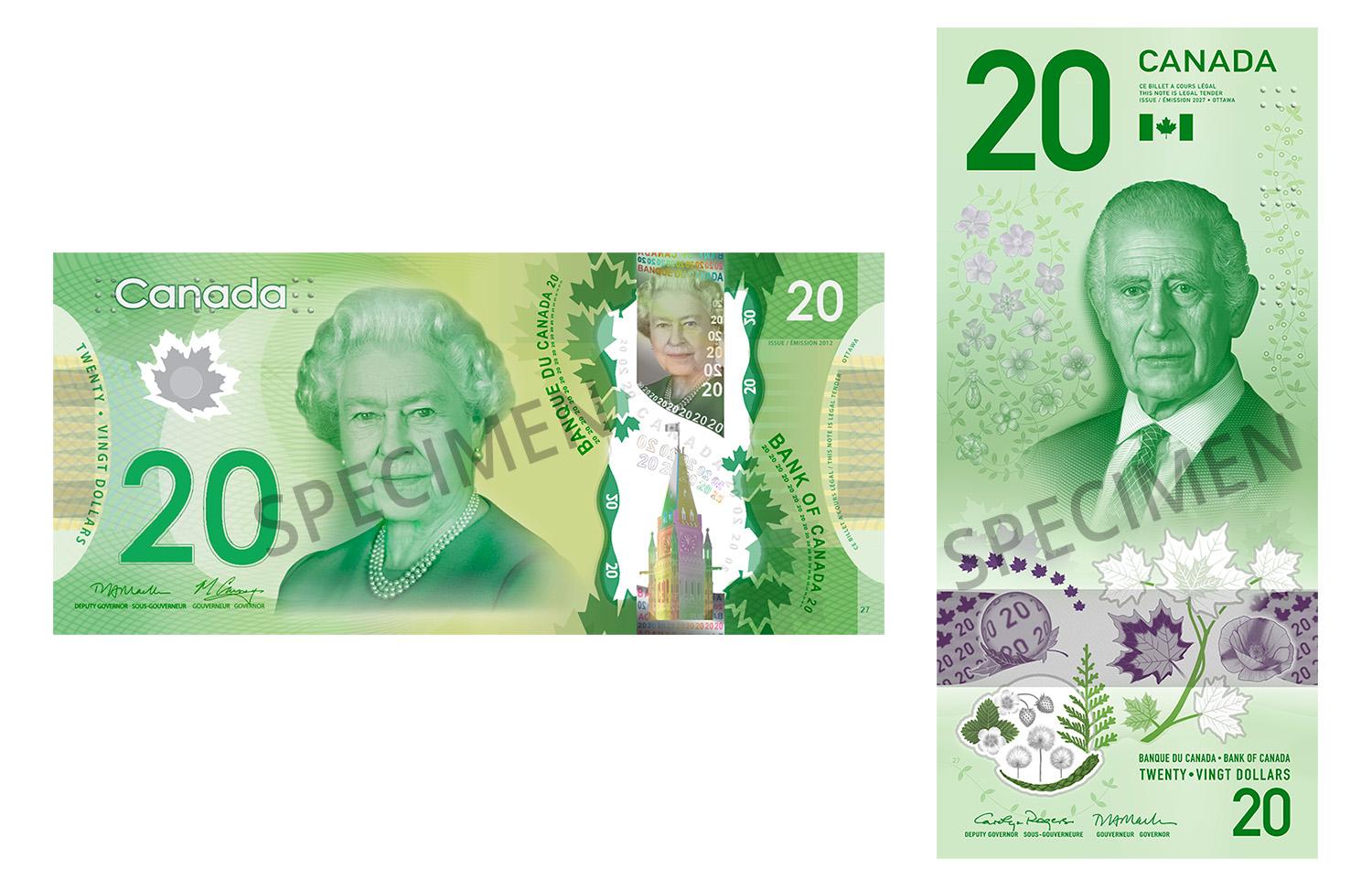
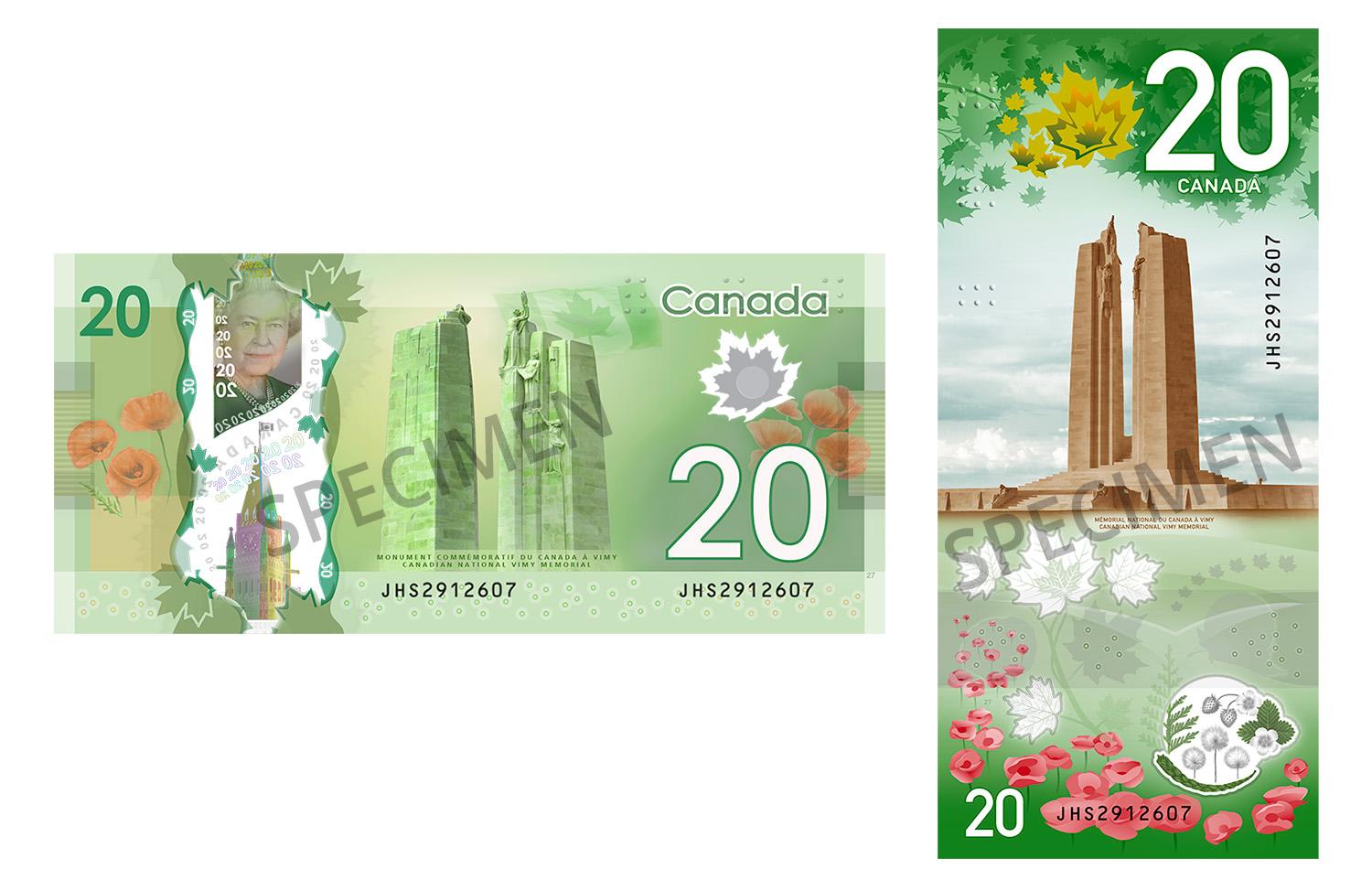
On the left is the $20 bank note from the Frontiers series, released in 2013. On the right is the $20 bank note from the Vertical series, that will be released in 2027.
Ask your students:
- What is different about the new $20 bank note? What is the same?
- The portrait is of King Charles III.
- The note is vertical.
- The Canadian National Vimy Memorial is still depicted, but it is a new image.
- Security features:
- The new $20 bank note has some new security features including a security stripe with a bubble that looks 3D, a maple leaf that pulses, a poppy with bands that spin inside the petals, and a background where 20s change into maple leaves.
- Gold maple leaves on the back with inner leaves that pulse
- Symbols to represent Canada:
- Four plants that are culturally significant to Indigenous People in Canada, chosen by the Bank of Canada’s Indigenous Advisory Circle
- The provincial and territorial flowers of Canada
- A Canadian flag
- Additional poppies and maple leaves
- Why would the bank note need to be redesigned?
- When the Bank of Canada designs a new bank note, it uses the most innovative security features available, to keep ahead of counterfeiting and new technology. The last $20 bank note was issued in 2012 and technology has since evolved.
- The $20 bank note also features the current monarch of Canada, King Charles III, after the death of Queen Elizabeth II. The Government of Canada has committed to featuring the reigning monarch on our $20 bills.
- The Bank of Canada will be replacing all the last series of notes with new, vertical notes, one at a time. The $20 is the second note in the Vertical series, after the $10 bank note featuring Viola Desmond, issued in 2018.
The $5 bank note will be the next note issued in the Vertical series. In 2024, the minister of finance announced that Terry Fox will be featured on this bank note. See Our next $5 bank note for more information.
2.3 Video and worksheet
Hand out the “Security feature worksheet” and instruct students to fill out as much as they can while watching the video. Pay careful attention to each step: feel, look, tilt and flip. These are the steps they can follow to check a bank note.
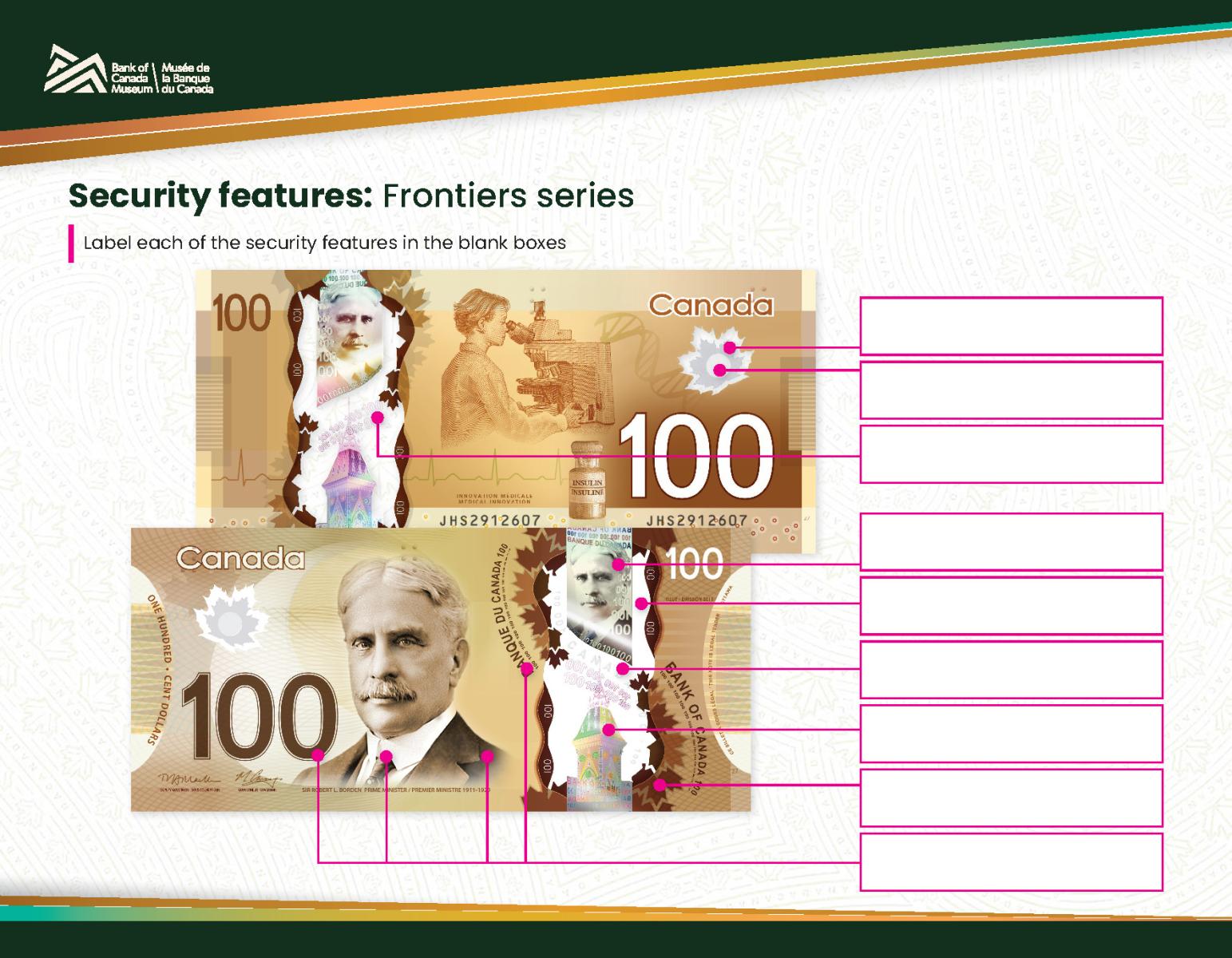
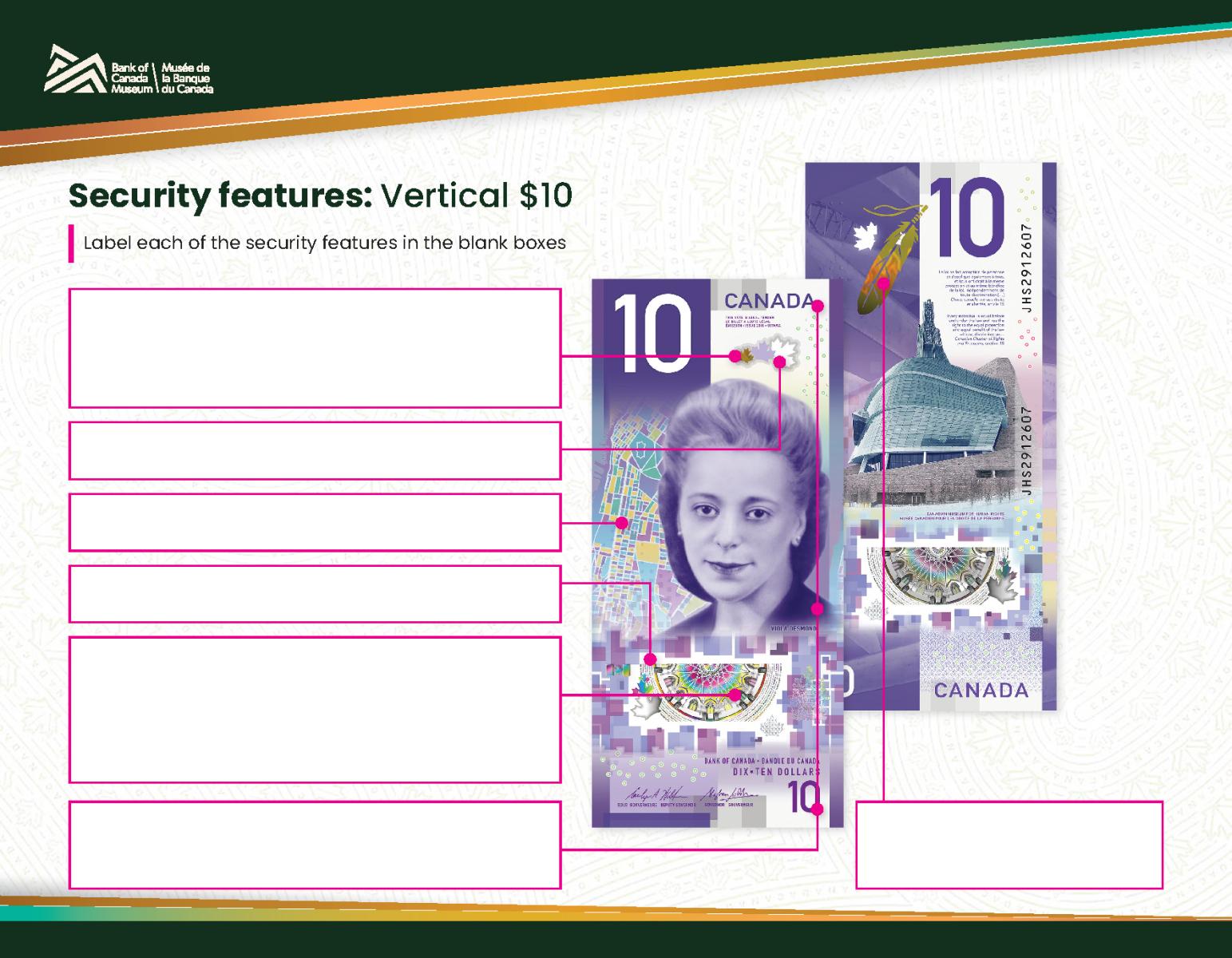
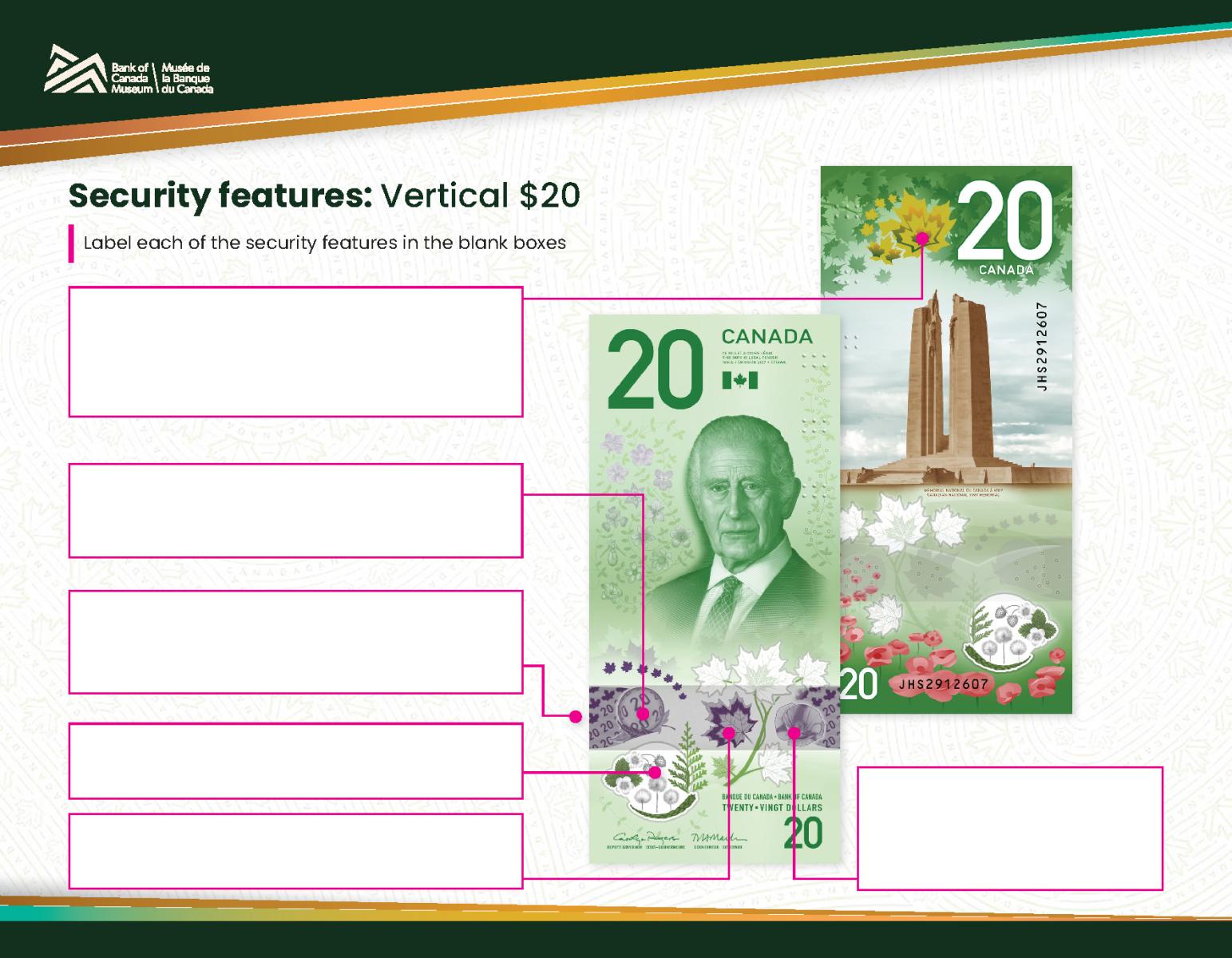
Spot and identify security features of the $10 and $20 bank notes on these worksheets.
Play the Bank of Canada’s The $10 bank note featuring Viola Desmond: security features video.
A summary of the security features on the vertical $10 note.
Do the same thing, filling out the second page of the worksheet, with the Bank of Canada’s video Canada’s Vertical $20 bank note.
A summary of the security features on the vertical $20 note.
Explain to students that they’ve just learned about the Vertical $10 and $20 in these videos. But the Frontiers series $5, $50 and $100 are still circulating, and they’ll see a lot of the Frontiers $20 still too, since the new $20 will enter circulation slowly. They may even see an occasional Frontiers $10, although those are pretty rare these days.
But it’s not as daunting as it might sound. Review the current bank notes on the Bank of Canada’s website, together on a projector or on individual devices. All of the notes in the Frontiers series have the same security features. Click the Frontiers series $50. Note which features are the same as the Vertical $10 and $20 by scrolling through the page. Add the security features to the worksheet. Review the worksheet together using the answer key and fill in anything that’s missing.
Students can familiarize themselves with the security features of the other bank notes from the Frontiers series they may encounter online.
2.4 Security features through time
Ask your students:
- How many times do you think Canadian bank notes have changed?
- The appearance of Canadian bank notes has changed many times. As new series of bank notes are released, the old ones leave circulation, and you don’t see them as often. Releasing new bank note series helps the Bank of Canada stay ahead of counterfeiters.
- To date, there are 7 complete series. The Bank of Canada has begun the eighth, the Vertical series. Commemorative notes also exist outside of the series, and they also have unique security features.
- First series, 1935
- Bilingual series, 1937
- Canadian Landscape series, 1954
- Scenes of Canada series, 1969–1979
- Birds of Canada series, 1986
- Canadian Journey series, 2001–2006
- Frontiers series, 2011–2013
- Vertical series, 2018–present
Show your students or share with them digitally, the Bank of Canada Museum resource, Complete bank note series, where they can explore each series in more detail.
- Just as the images and symbols have changed, so have the security features. The Bank of Canada uses the latest technologies to keep bank notes secure. However, as new printing and imaging technology becomes more available to the public, counterfeiters can catch up. That is why it is so important for bank notes to be updated with the newest security features.
Here’s a quick look at how security features have evolved to thwart counterfeiters as technology has changed. The article Security is in the bank note provides a more detailed explanation of each series.
The First series (1935), the Bilingual series (1937) and the Canadian Landscape series (1954)
These bank notes had raised ink, which was thick and easily felt on the front and back of the note, intricate fine-line patterns, small green dots called planchettes scattered randomly in the paper and intricate guilloche printing. Most counterfeiting protection came from designing new bills.
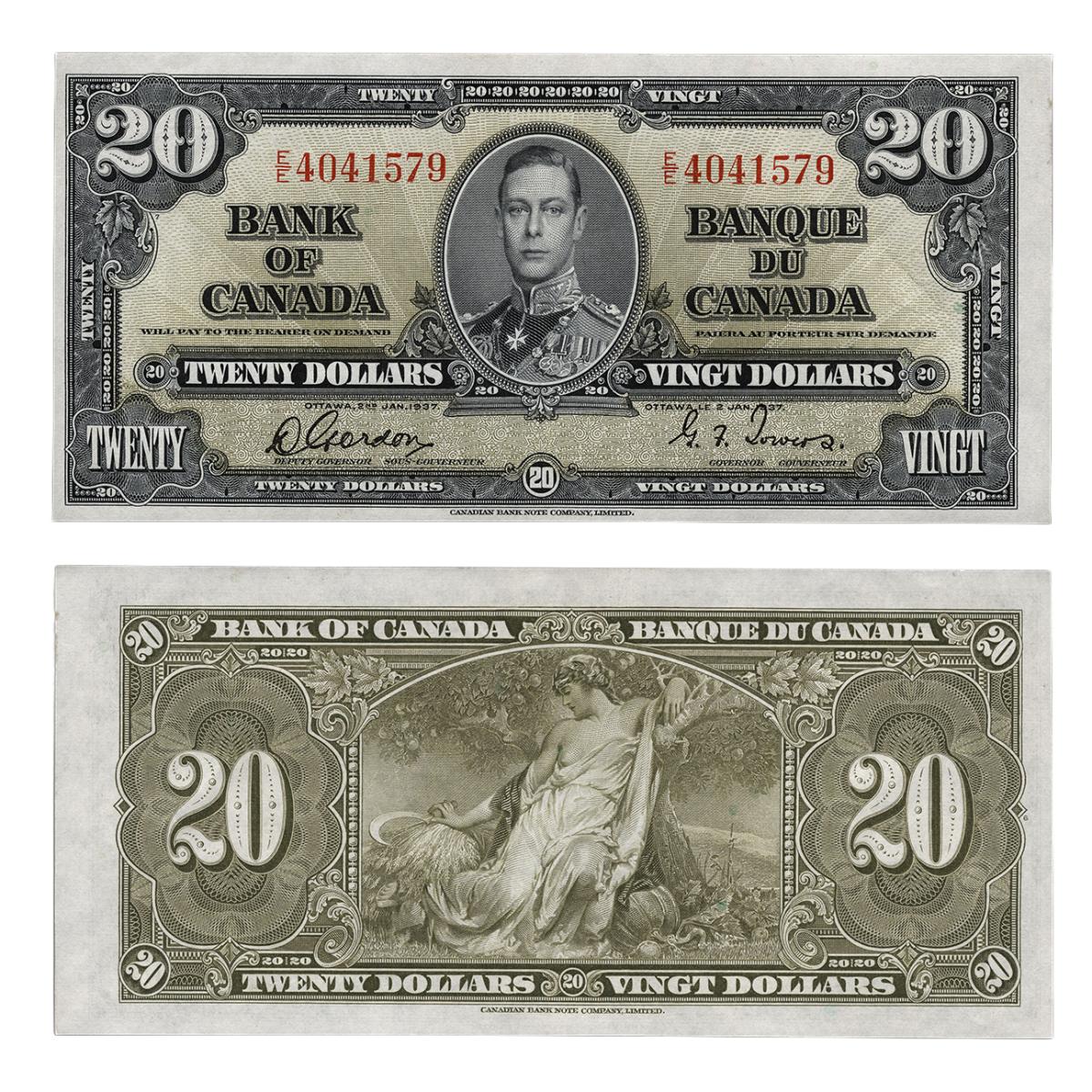
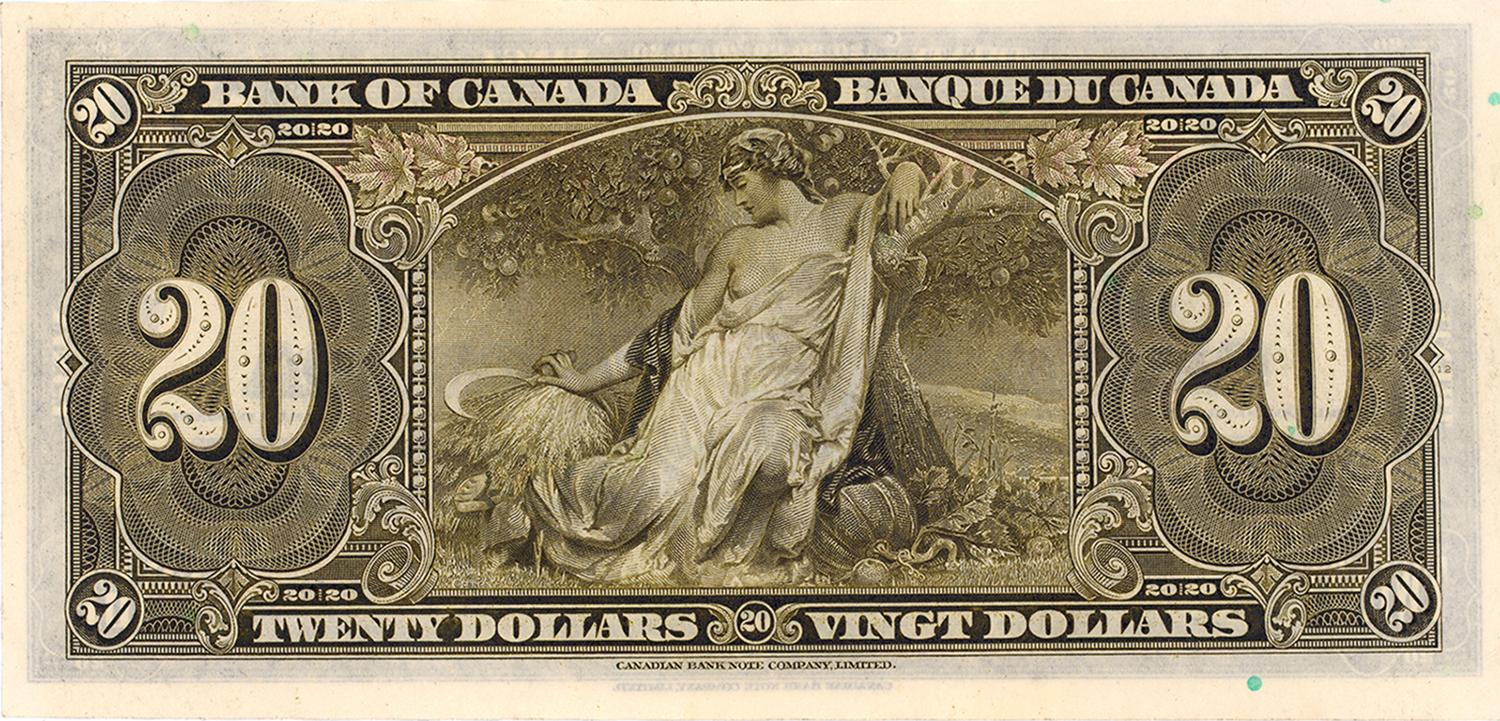
The $20 bank note from the Bilingual series
Source: 20 dollars, Canada, 1937 | 1992.9.32
Scenes of Canada series (1969–1979)
The Scenes of Canada series used a technique known as rainbow printing that merged two or more colours into each other. The series used a lithographic process and featured a brilliantly coloured coat of arms, intricate patterns filling blank areas and guilloche patterns around the denominations.
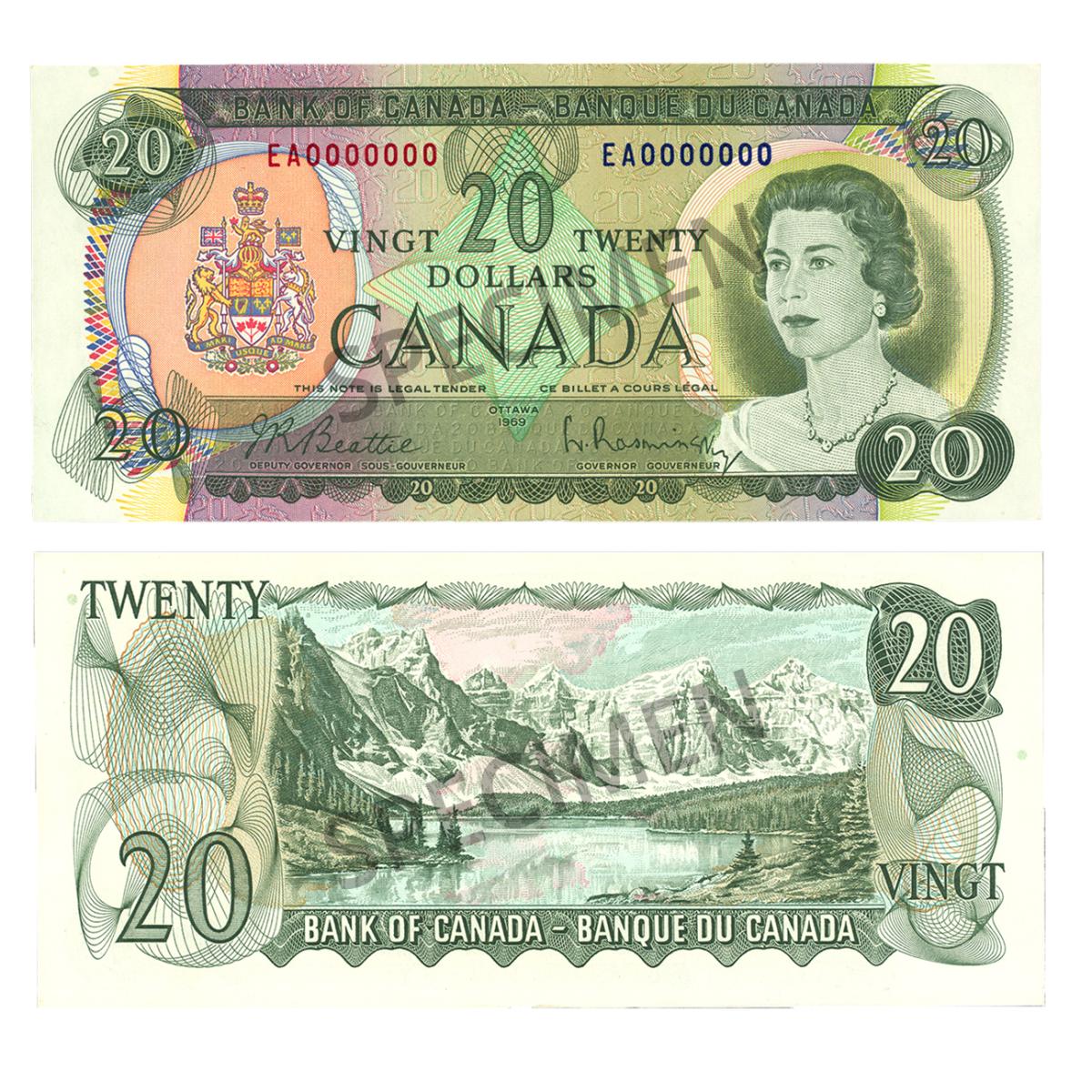
The $20 bank note from the Scenes of Canada series
Source: 20 dollars, Canada, 1969 | 1992.37.52
Birds of Canada series (1986)
Bank notes in the Birds of Canada series featured a metallic patch, raised ink, green dots and microprinted words and lines. The microprinted lines were key for foiling counterfeiters. The fine and closely spaced lines appeared as blank, toned areas. But when scanned or photocopied, curious waves—called moiré patterns—emerged.
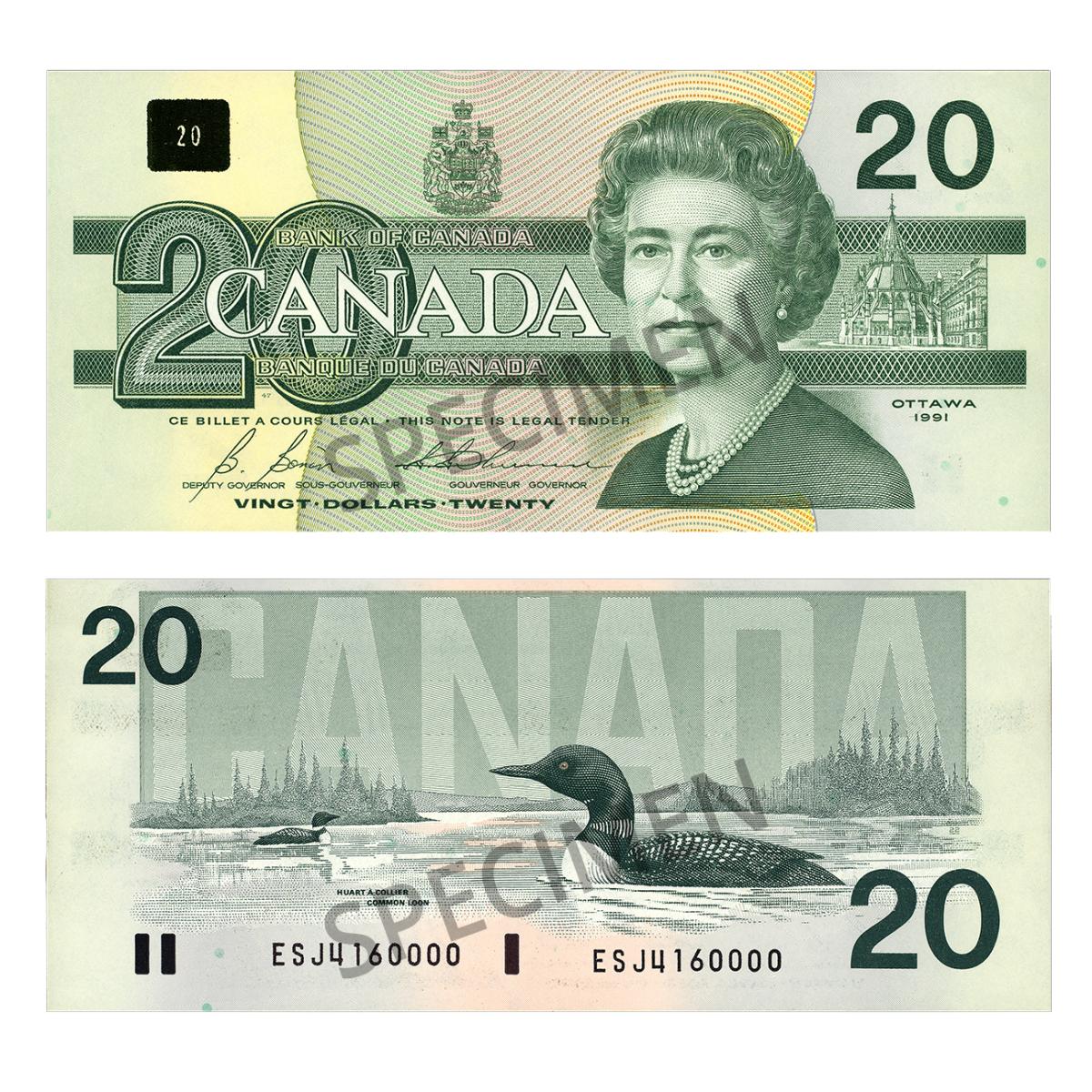
The $20 bank note from the Birds of Canada series
Source: 20 dollars, Canada, 1991 | 1995.33.7
Canadian Journey series (2001–2006)
Bank notes in the Canadian Journey series featured a metallic strip, a ghost image, dashes, a puzzle number, raised ink and a feature that was only visible under ultraviolet light.
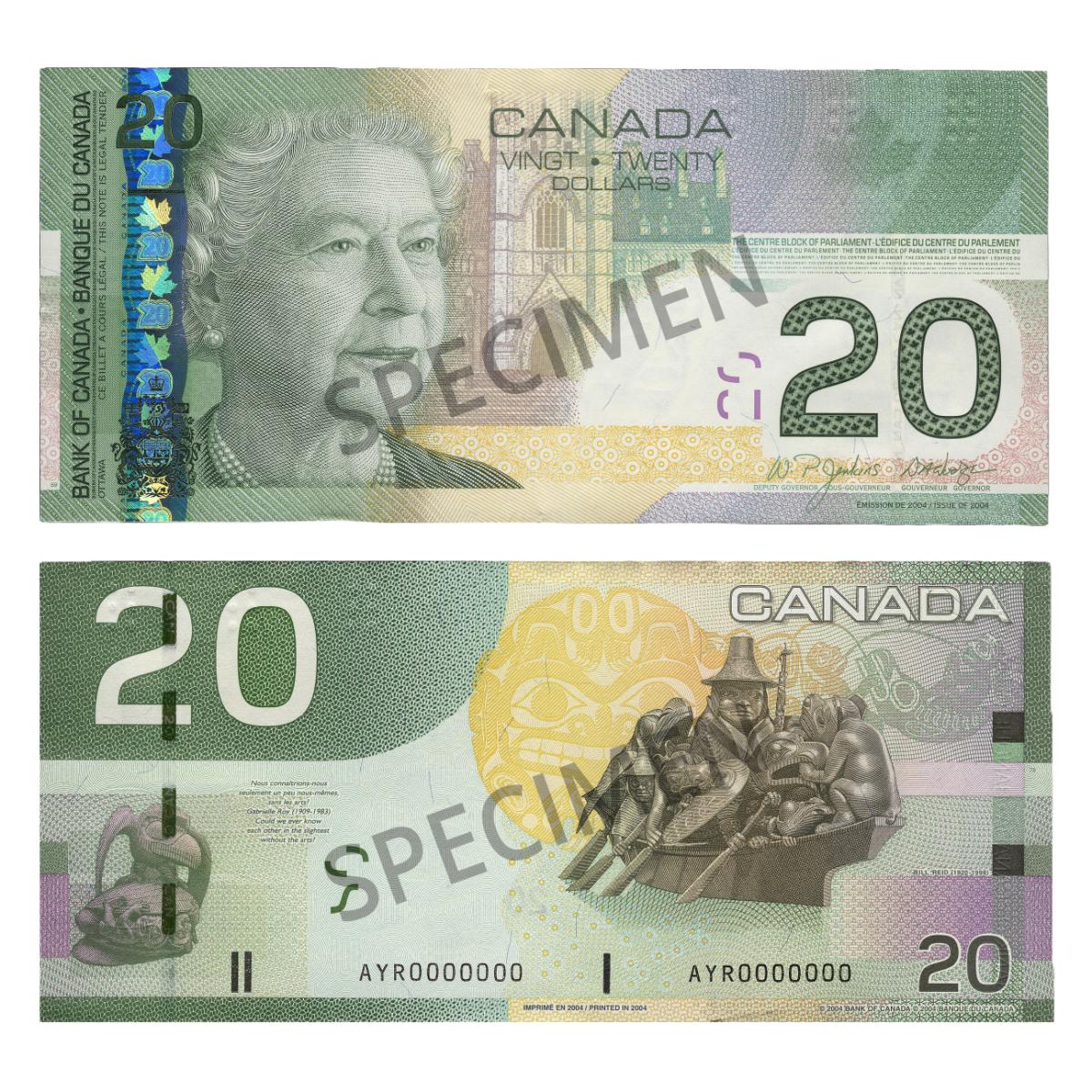
The $20 bank note from the Canadian Journey series
Source: 20 dollars, Canada, 2004 | 2008.14.10
Frontiers series (2011–2013)
This was the first Canadian series to be printed on polymer. The Frontiers series features raised ink, metallic elements that change colour on both sides of the clear window, a frosted maple leaf window with a transparent outline and hidden numbers inside, the word “Canada” and numbers that match the denomination in the large window, and maple leaves bordering and crossing into the large window.
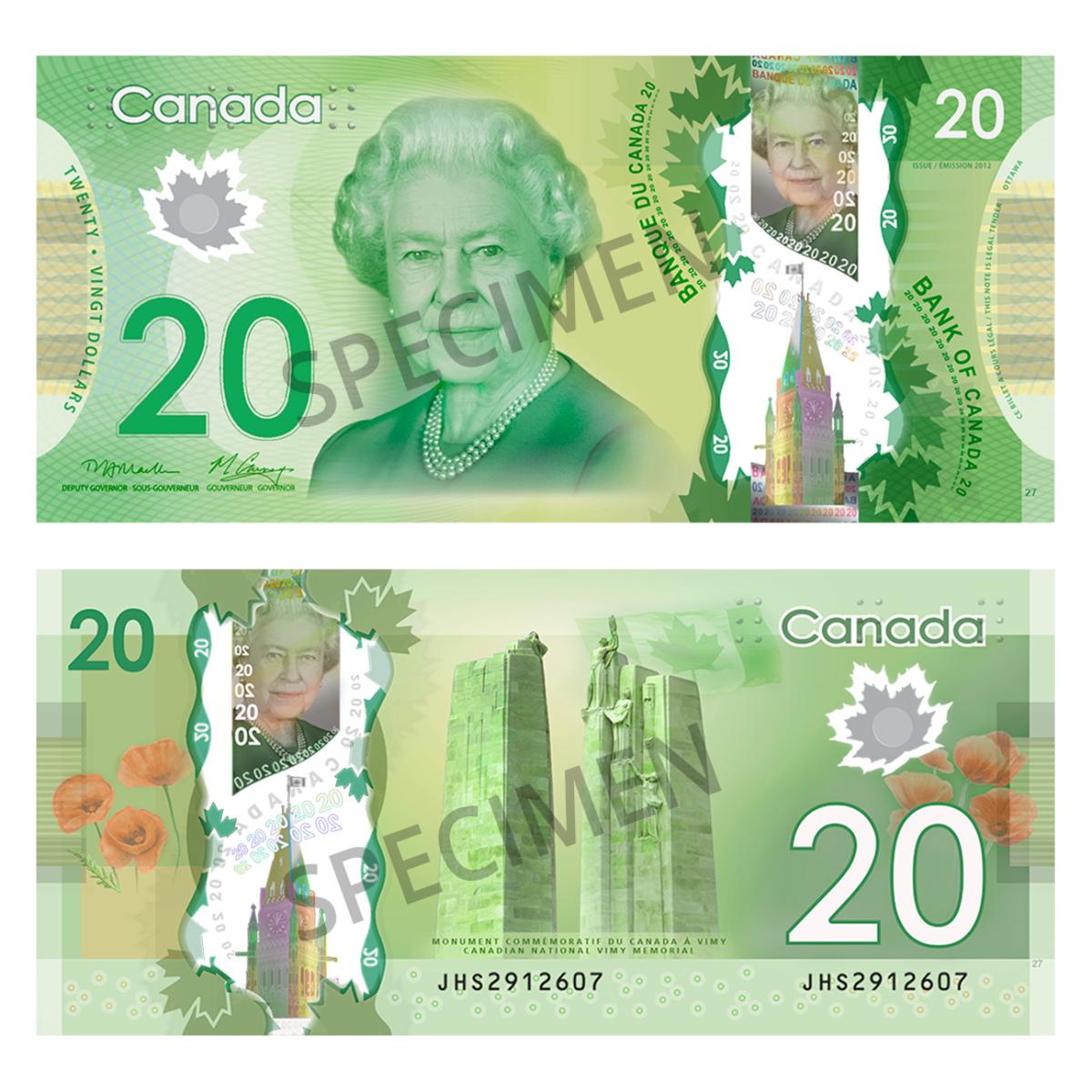
The $20 bank note from the Frontiers series
Source: 20 dollars, Canada, 2011 | 2016.56.3
Vertical series (2018 to present)
This is the second series of polymer notes. The $10 and the $20 bank note are the first two notes of this series and they have different security features.
The $10 bank note is printed on polymer with a large transparent window, raised ink and metallic symbols and images within the transparent window, including a three-dimensional maple leaf. On the back, there is an eagle feather that changes colour. There is also a transparent maple leaf that is visible on both sides of the note.
The $20 bank note is printed on polymer and has raised ink and a security stripe with multiple dynamic images, including a bubble that looks 3D, a pulsing maple leaf, a poppy with bands that spin inside the petals, and a background pattern where 20s change into maple leaves. On the back, it has gold maple leaves with inner leaves that pulse when you move the bank note.
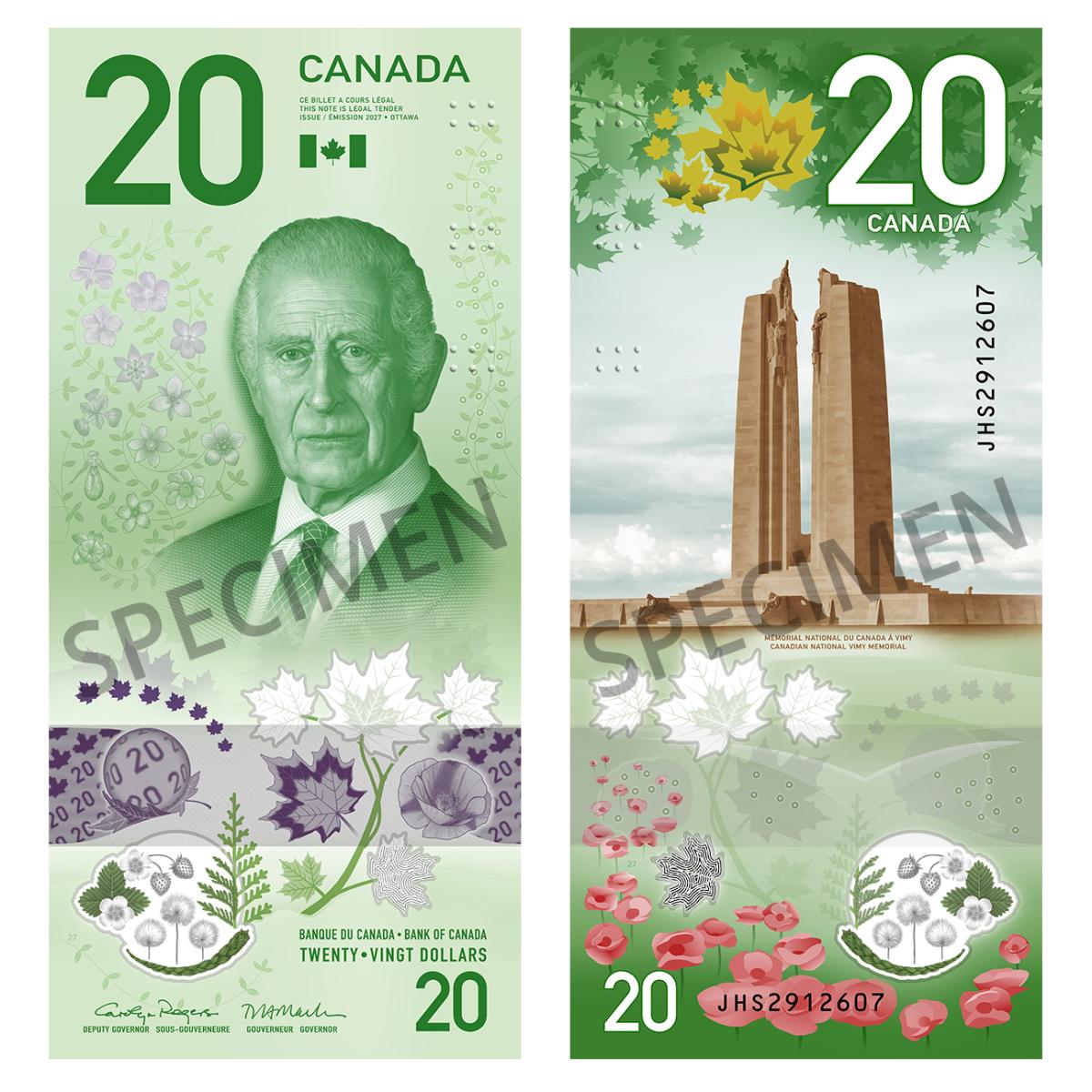
The $20 bank note from the Vertical series
Polymer bank notes are not only more secure than paper notes, they have a smaller environmental footprint too. Polymer notes last about four times longer and can be recycled. Learn more about the Lifespan of a bank note.
Activity 3: Spotting counterfeit notes
Students will role play scenarios they might encounter if they spot a counterfeit bank note.
Time
40 minutes
3.1 What to do?
As a class, watch a video and read about counterfeit prevention.
3.2 Role play
Ask your students:
- What are some of the situations where you think you might find a counterfeit bank note?
Capture ideas on the white board or chart paper to create a list of scenarios. If you need more scenarios, add some of these:
- selling an old cell phone through an online marketplace
- waiting tables at a busy restaurant
- working at a coffee shop that’s open 24 hours
- hosting a garage sale
- babysitting
- pet-sitting or dog-walking
- selling snacks and drinks at a school event
- working at a stall in a farmer’s market
- tutoring
Ask the students to choose a partner. Each pair should act out one scenario, where one plays the person with the counterfeit bank note and the other plays the person receiving the note. Tell students to remember to:
- Check the bank note before accepting the transaction.
- Stay calm during the transaction.
- Don’t accuse the other person of fraud. Many people don’t know they have a counterfeit bank note.
- Ask the person to bring the bank note to the police for verification.
- Tell your supervisor as soon as possible or contact the police yourself.
If you are accepting cash as payment from a stranger on an online marketplace, always do so in a public place. You can meet in front of a police station, a grocery store, a bank, etc. Always bring someone else with you.
Activity 4: Review bingo
Students will review and build familiarity with the security features of polymer bills.
Time
30 minutes
4.1 Fill out cards
Give each student a blank bingo card to fill out.
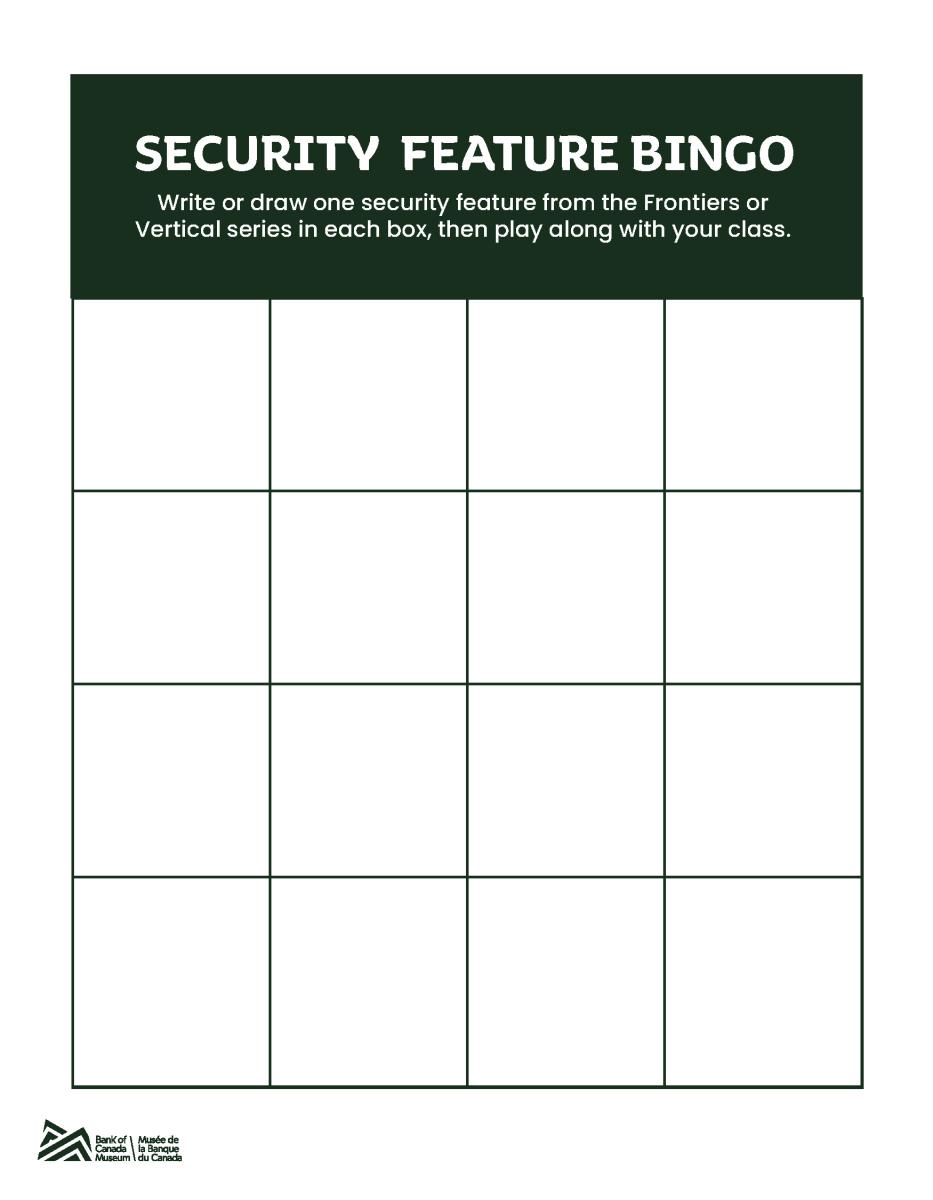
Students will fill out their own Bingo card and then play security features Bingo as a class.
Post the list of security features for the Frontiers and Vertical series for students to reference.
Instruct students to fill in each box with one of the security features. Remind students to indicate which series the feature belongs to (they could use separate colours or put an “F” or a “V” next to the feature). Students must fill in their entire card. There won’t be enough spaces for all the security features but advise them to use some from each series and bank note.
Security features
On all current series
- smooth texture of polymer
- raised Ink
Frontiers Series
- metallic portrait and building
- large window
- small numbers that match the note’s value
- maple leaf border
- frosted maple leaf window
- hidden numbers
Vertical Series
On the $10 bank note:
- maple leaves above the portrait
- large transparent window with detailed metallic images and symbols
- three-dimensional maple leaf
- transparent maple leaf
- eagle feather that changes colour
On the $20 bank note:
- purple security stripe
- bubble that looks 3D
- pulsing maple leaf
- poppy with band spinning inside the petals
- background where the number “20” changes into maple leaves
- gold maple leaves with inner leaves that pulse
4.2 Bingo
The teacher acts as the caller. Instead of calling out numbers under letters, display the image of the Frontiers $50, the Vertical $10 and the Vertical $20 on the screen and point to one of the security features (but don’t name it).
- Students will mark off the corresponding security feature on their bingo card.
- Record a list of the security features you’ve pointed to.
- Continue playing until all students get a complete row and you’ve shown all three bank notes.
- Point carefully—some of the features are close together.
Conclusion
Students will demonstrate their understanding with an exit card.
Time
5 minutes
Exit card
Give each student a blank card. Students will need to write two security features from any of the polymer bank notes (Frontiers or Vertical series) on the card and submit it at the end of the lesson. In exchange, provide students with a certificate of completion for their records.
Extensions
- Learn about how the Bank of Canada has made the security features and design of bank notes more accessible from Bank notes: Resources for the blind and partially sighted. Discuss how accessibility has been improved and why it’s important. How might individuals with other disabilities be helped by accessible bank note design?
- Preventing fraud isn’t only about checking bank notes. Ask your students to research other types of fraud they might be vulnerable to. Start with the Competition Bureau’s Little Black Book of Scams and the Canadian Anti-Fraud Centre. Students could present a scam to the class in small groups.
- To learn more about bank notes and historical thinking, see our lesson A bank NOTE-able Canadian for grades 6–10 (Secondary 4).
- View our video and discussion guide The life of a polymer bank note to follow a polymer bank note from design to recycling.
- Explore the history of bilingualism on bank notes with our blog post “Bank Note / Billet de banque.”
We want to hear from you
Comment or suggestion? Fill out this form.
Questions? Send us an email.
Content type(s):
Lesson plans