The Olympic Coin Program was novel, ambitious, record-breaking and for some, life-changing—much like the Olympic Games that the program helped finance.
It took encouragement from a friend for Ancaster, Ontario artist Lynda Cooper to enter the Montréal Olympic Organizing Committee’s coin design competition. She won, and her efforts were rewarded with a generous cash prize, instant fame and a long, productive career as an artist. Not to mention that more than 3 million impressions of her artwork were borne on a unique medium—a silver coin. And still to this day, Ms. Cooper thanks her friend for that push to success. That friend, it turns out, went on to become her husband!
Win #1: Montréal’s bid for the Olympic Games
The 1976 Montréal Olympic Games were momentous for several reasons:
- They were the first Games hosted by Canada.
- They launched an ambitious collector coin program to help cover costs.
- They distinguished a young female artist from London, Ontario.
When Montréal was selected as the host city by the International Olympic Committee in May 1970, the organizers—including Mayor Jean Drapeau—immediately touted the merits of the decision. They boasted that the Games were going to pay for themselves thanks to novel funding programs, such as the launch of a series of commemorative silver (and later gold) collector coins.
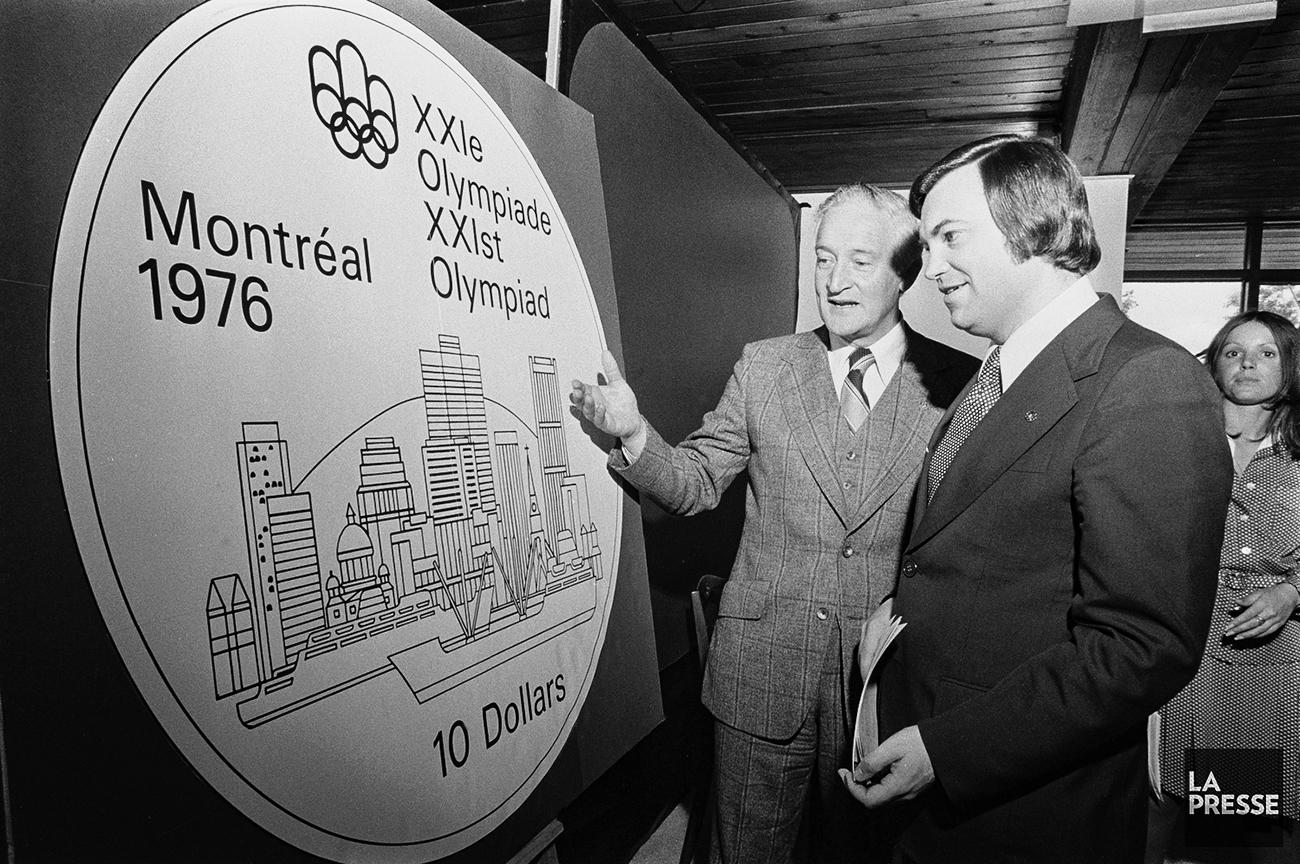
In September 1973, Postmaster General André Ouellet (right) and Roger Rousseau, President of the Montréal Games Organizing Committee (left), unveiled the designs for the first Montréal Olympic coin series.
Source: 19 septembre 1973, Archives nationales à Montréal, Fonds La Presse, (06M,P833,S5,D1973-0440), Pierre McCann.
Win #2: Launch of the Olympic Coin Program
Bill C-196, which later became the Olympic (1976) Act, was passed on June 28, 1973. It called for the minting of commemorative coins and stamps to help fund the Games. A month later, the Olympic Coin Program was created, with the Minister of Finance named as financial administrator.
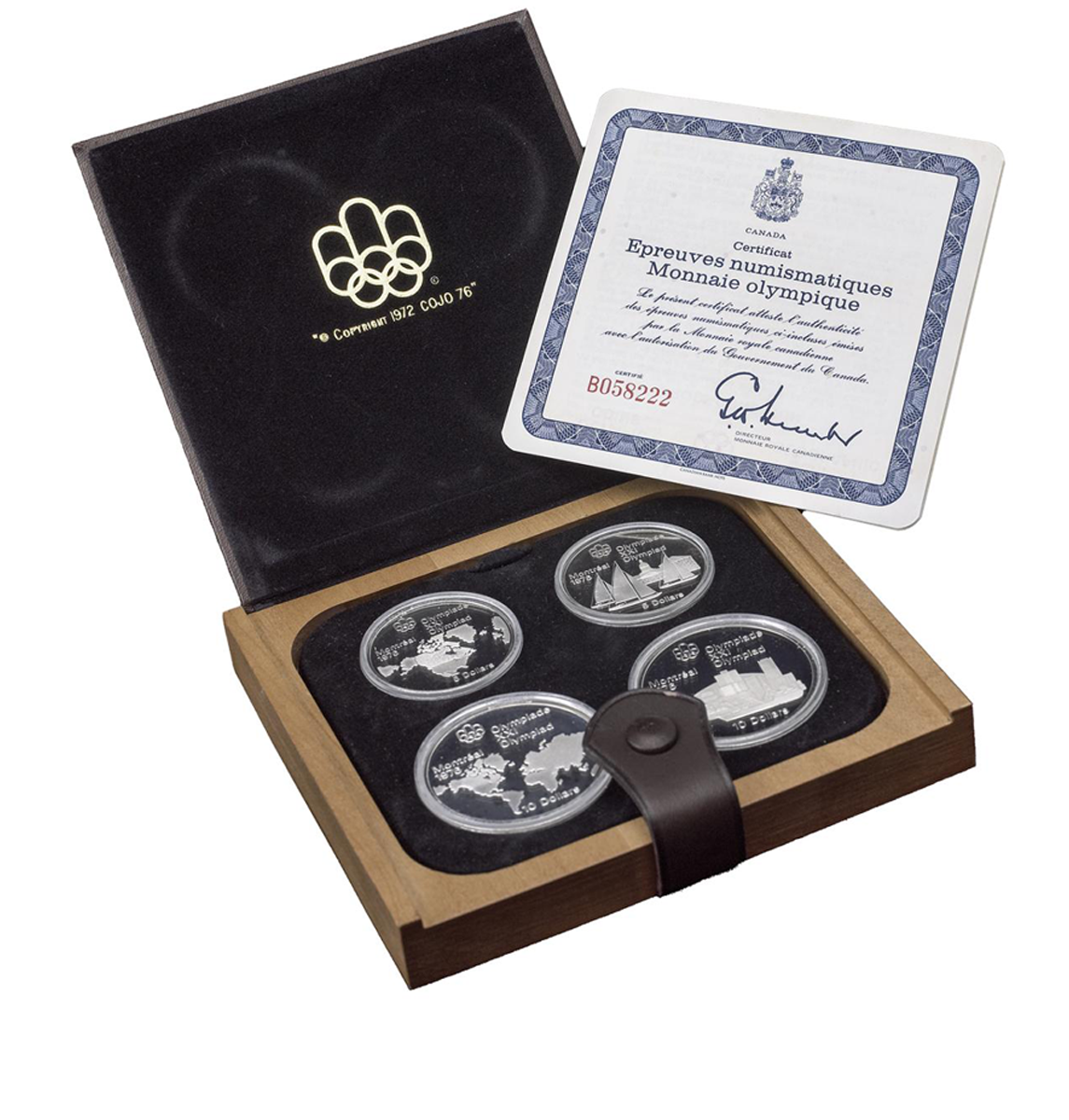
The first series of coins was unveiled in August 1973. The sterling silver coins had a geography theme, and the series consisted of two $5 and two $10 coins. They went on sale to the Canadian public on December 12, 1973. Of the 9 million coins from the first series, 1 million were distributed to financial institutions and numismatic outlets and sold at face value. The remaining coins were sold as singles or as sets in a variety of presentation cases. In both proof and brilliant uncirculated finishes, they sold at different price points.
Postmasters General André Ouellet (November 1972–August 1974) and Bryce Mackasey (August 1974–September 1976) were responsible for the promotion, distribution and merchandising of the coins both within and outside Canada. The Olympic Organizing Committee–or the Comité d’organisation des Jeux Olympiques (COJO)–oversaw planning and operations. The team was also involved in the selection process for the coin designs. The Royal Canadian Mint was contracted to mint the coins, prepare the sets and distribute them to financial institutions, post offices and numismatic dealers across Canada.
The Olympic Coin Program was the first major coin program with an objective of covering the substantial costs of construction and of hosting the Games. Expectations were high, and so was public interest. Orders to the Olympic Coin Program poured in faster than the Royal Canadian Mint could produce the coins. The first series sold out in a matter of weeks. Officials wondered if their revenue expectations had been set too low.
Olympic coin designs
The Olympic Coin Program consisted of seven series of four coins each. Themes included geography, the ancient Games, Indigenous sports, sports history and the Olympic venues. Beginning in late 1973, a new set of coins was issued about every four months until the Montréal Games opened in July 1976. For the first four and final seventh series of Olympic coins, COJO approached several prominent Canadian artists, who agreed to create designs for the coins:
- Series 1: Geography—Georges Huel from Montréal, Quebec
- Series 2: Olympic motifs—Anthony Mann from Halifax, Nova Scotia
- Series 3: Early Canadian sports—Ken Danby from Sault Ste. Marie, Ontario
- Series 4: Olympic track and field sports—Leo Yerxa from Ottawa, Ontario
- Series 7: Olympic Games souvenirs—Elliott John Morrison from Toronto, Ontario
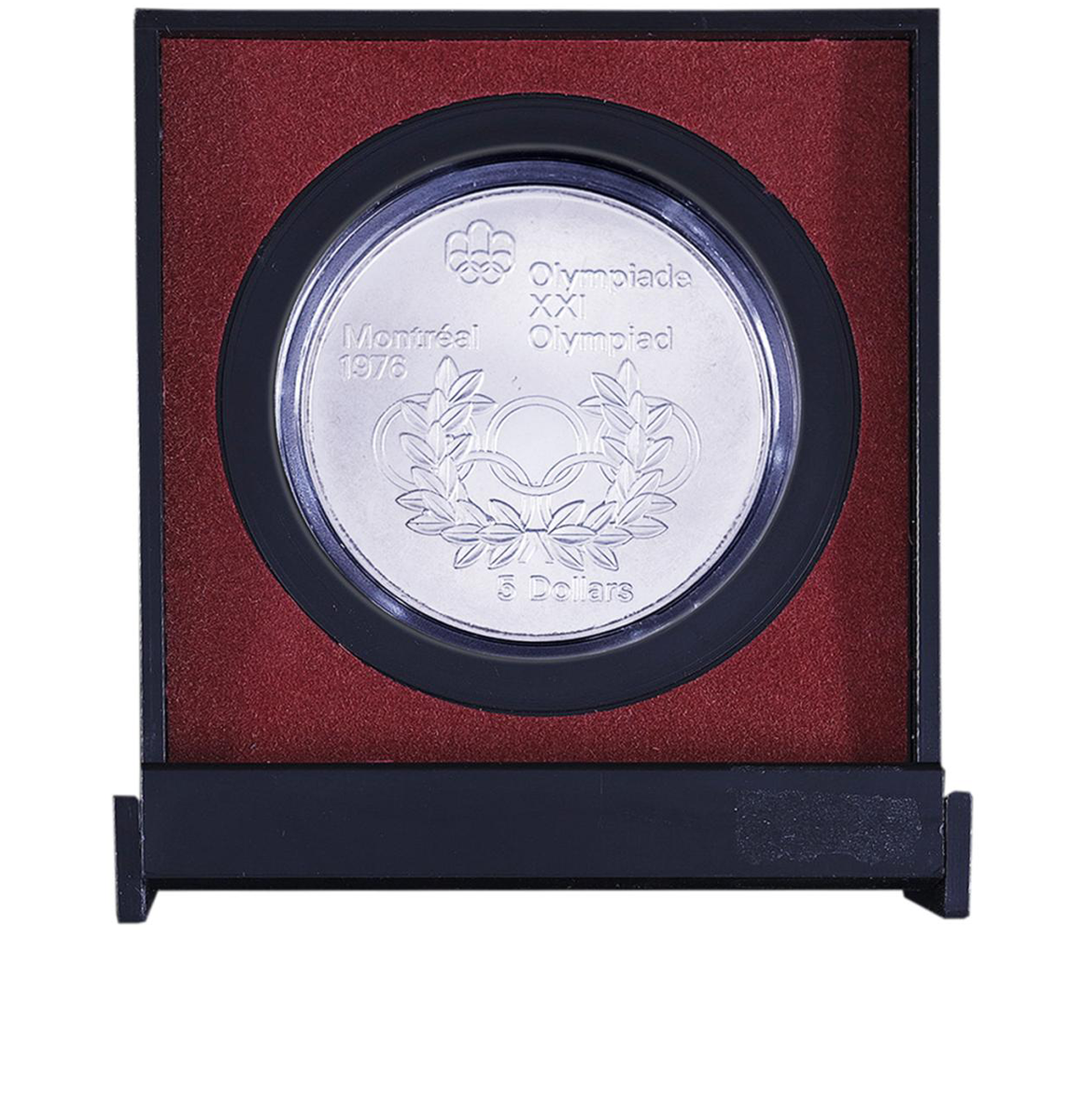
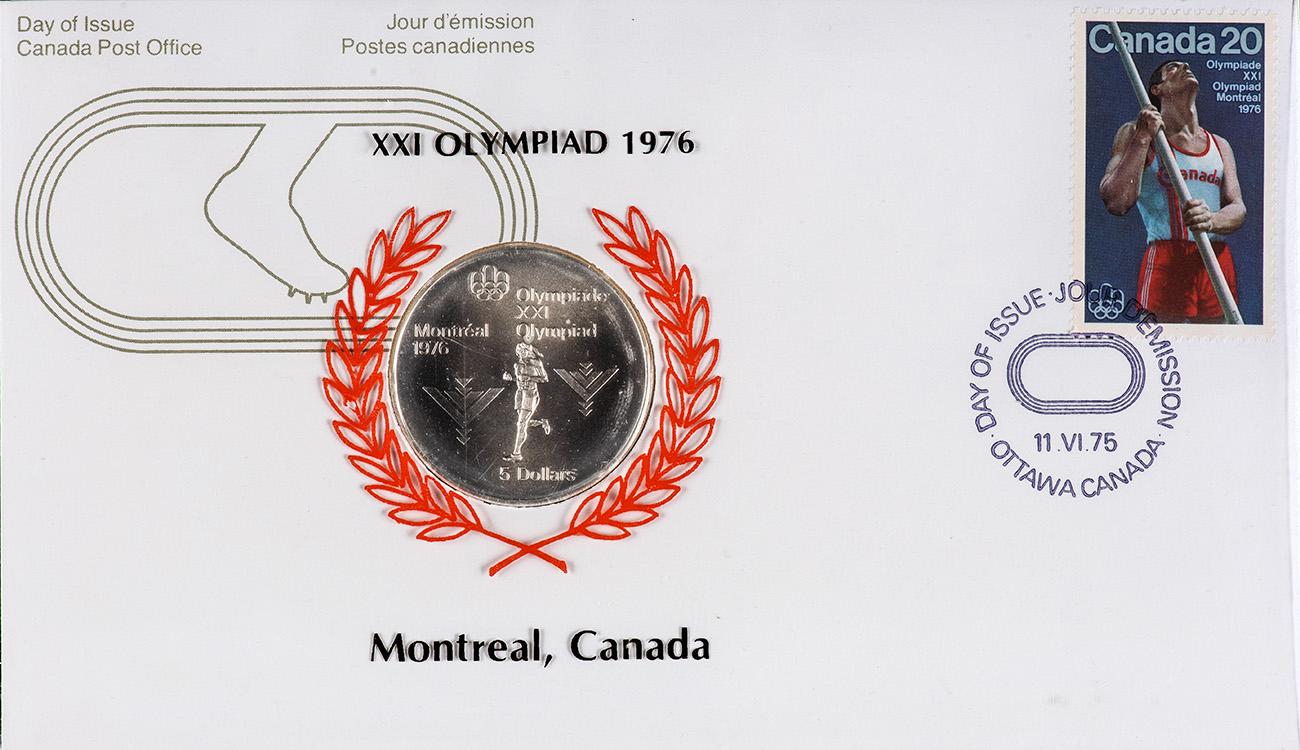
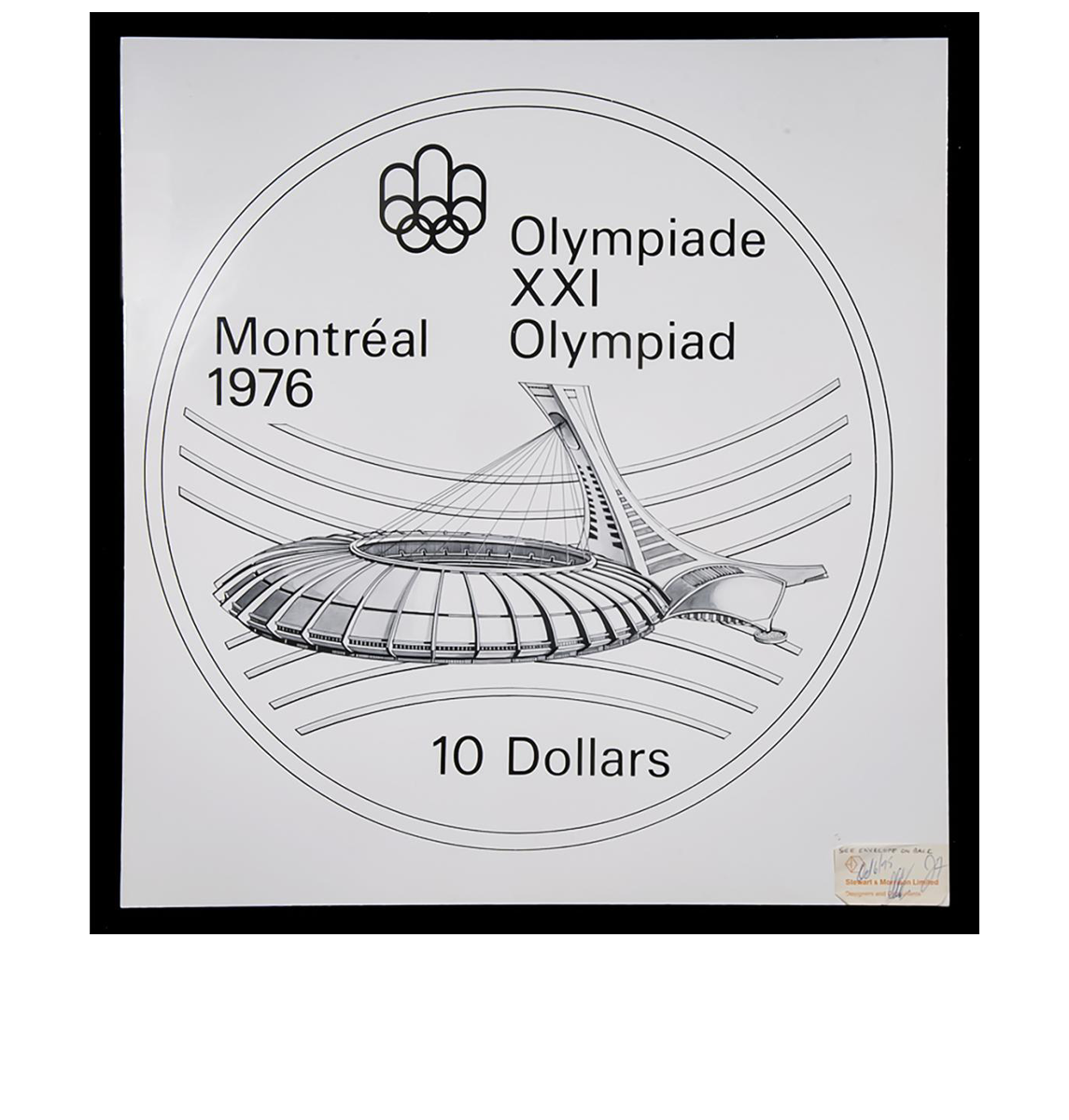
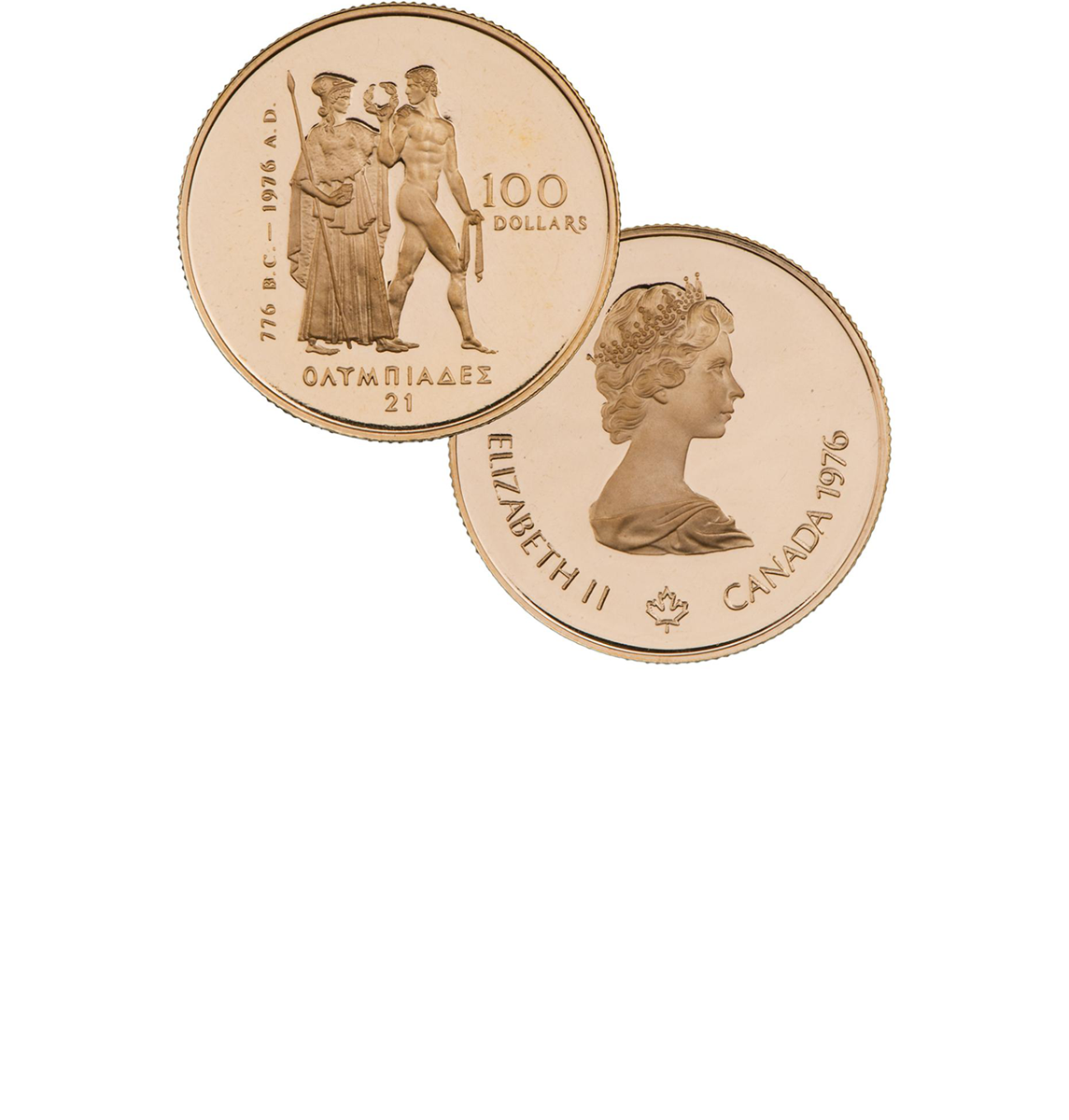
Canada was the first country to issue a gold coin for the Olympic Games. Famed Canadian sculptor Dora de Pédery-Hunt designed the reverse of the $100 gold coin: the Goddess Athena crowning a male athlete with a laurel wreath. The dates commemorate the first Olympic Games in Ancient Greece and the 21st Olympiad in 1976.
Source: Elizabeth II, 100 dollars, proof coin, 1976 | 1976.87.34
Source: Elizabeth II, 100 dollars, proof coin, 1976 | 1976.87.34
National and international competitions
To promote the Olympic Coin Program and encourage participation of Canadian artists and people from around the world, two design competitions were opened to the public. One, limited to Canadian citizens, was held for Series 5: Olympic water sports. The other was an international competition for Series 6: Olympic team and body contact sports.
Entrants were invited to send for a design package that included the rules and guidelines, a submission form and two templates on which to produce their artwork. The winner received $3,500, and the other three finalists were awarded $1,500 each.
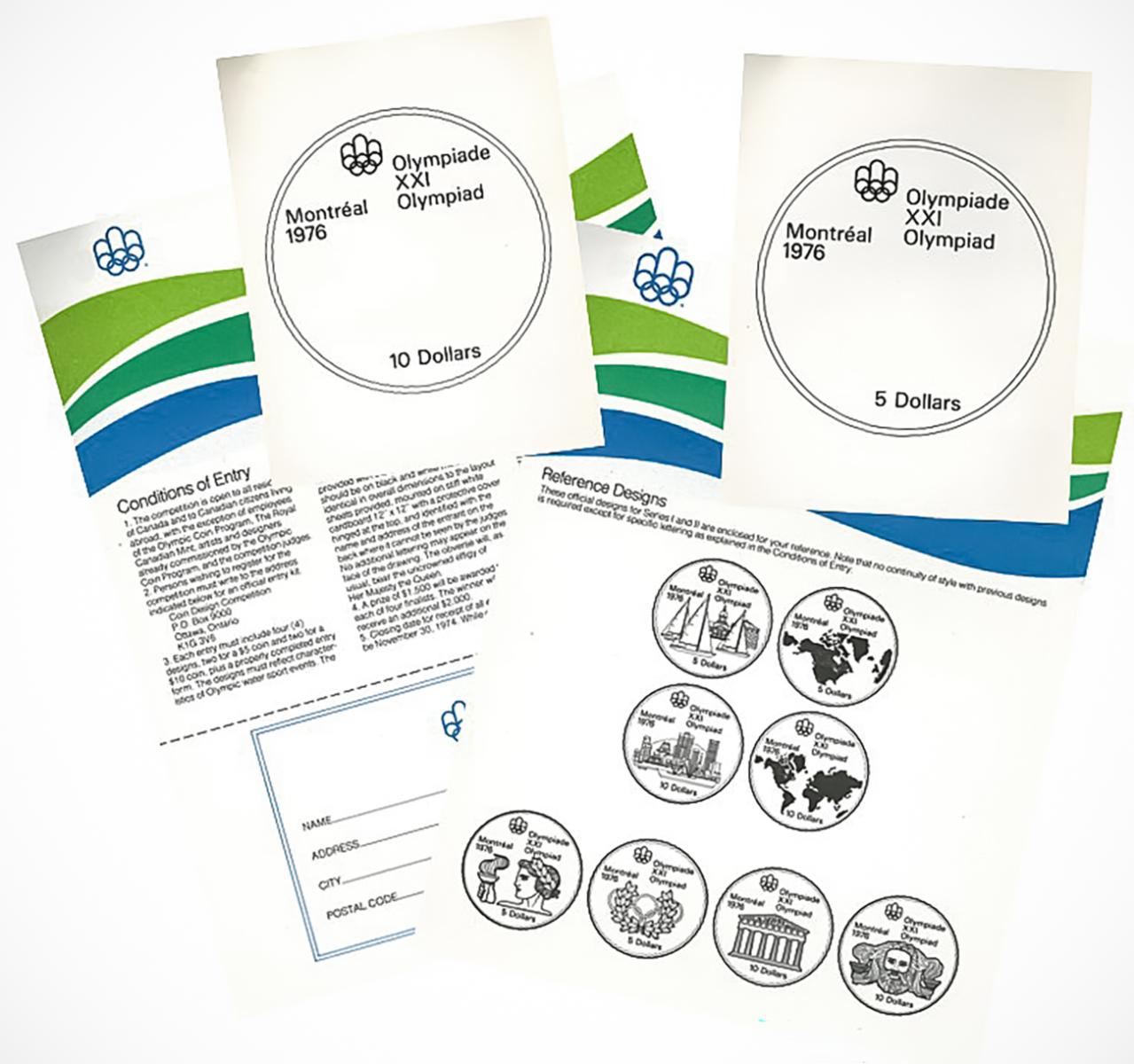
The entry form for the Canadian competition contained two templates for artists to produce their works for submission.
Source: Royal Canadian Mint records, Bank of Canada Museum Archives.
The selection committee for the Canadian competition consisted of five prominent Canadian artists: Kosso Eloul of Toronto, Ontario; Tom Forrestall of Dartmouth, Nova Scotia; Charles Gagnon of Montréal, Quebec; George Horvath of Calgary, Alberta; and Gordon Smith of Vancouver, British Columbia. A panel of five international judges oversaw the international competition, although their names were not revealed.
The international competition was open to any country that Canada maintained diplomatic relationships with and that was sending athletes and delegates to the Montréal Olympic Games. The Olympic Coin Program corresponded with several mints around the world, encouraging them to reach out to their network of designers and artists to enter the contest.
Japanese artist Shigeo Fukuda won the competition, and his designs of fencing, boxing, field hockey and soccer grace the reverses of the coins in Series 6. It is not known exactly how many entries COJO received for both competitions. The Bank of Canada Museum has several hundred original drawings from the Series 5 Canadian competition that were transferred from the Royal Canadian Mint in 1978.
Win #3: A path to a successful career in art
On September 25, 1975, Derek Dawson, Director of Products and Logistics for the Olympic Coin Program, announced the winner of the Canadian contest: Lynda Cooper. At the time, she was a 22-year-old art student living with her family in London, Ontario while attending Western University. A happy coincidence was that the announcement was made during the launch of an Olympic coin and art display at Wellington Square Mall in London, Ontario. It was the first stop on a Canada-wide tour to promote the coin program.
Cooper was training in sculpture, painting, photography and printmaking, and studying the history of fine art in university. During her schooling, she worked in the summer of 1974 as an illustrator and cartoonist for the Hamilton Spectator, a local newspaper in another city—a job that would lead to her eventual success as a coin designer.
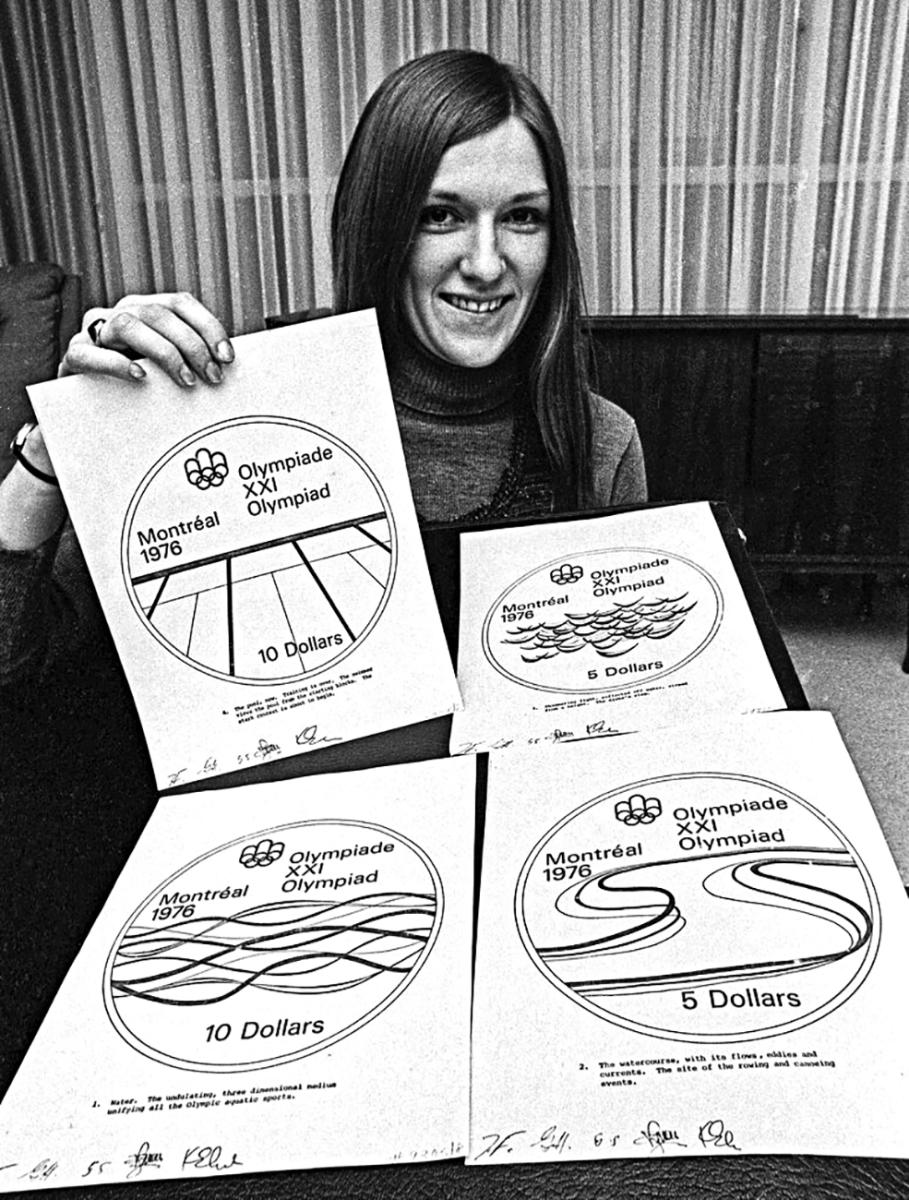
Contest winner Lynda Cooper shows off her winning designs.
Source: 7180055277. Archives and Special Collections, Western Libraries, Western University
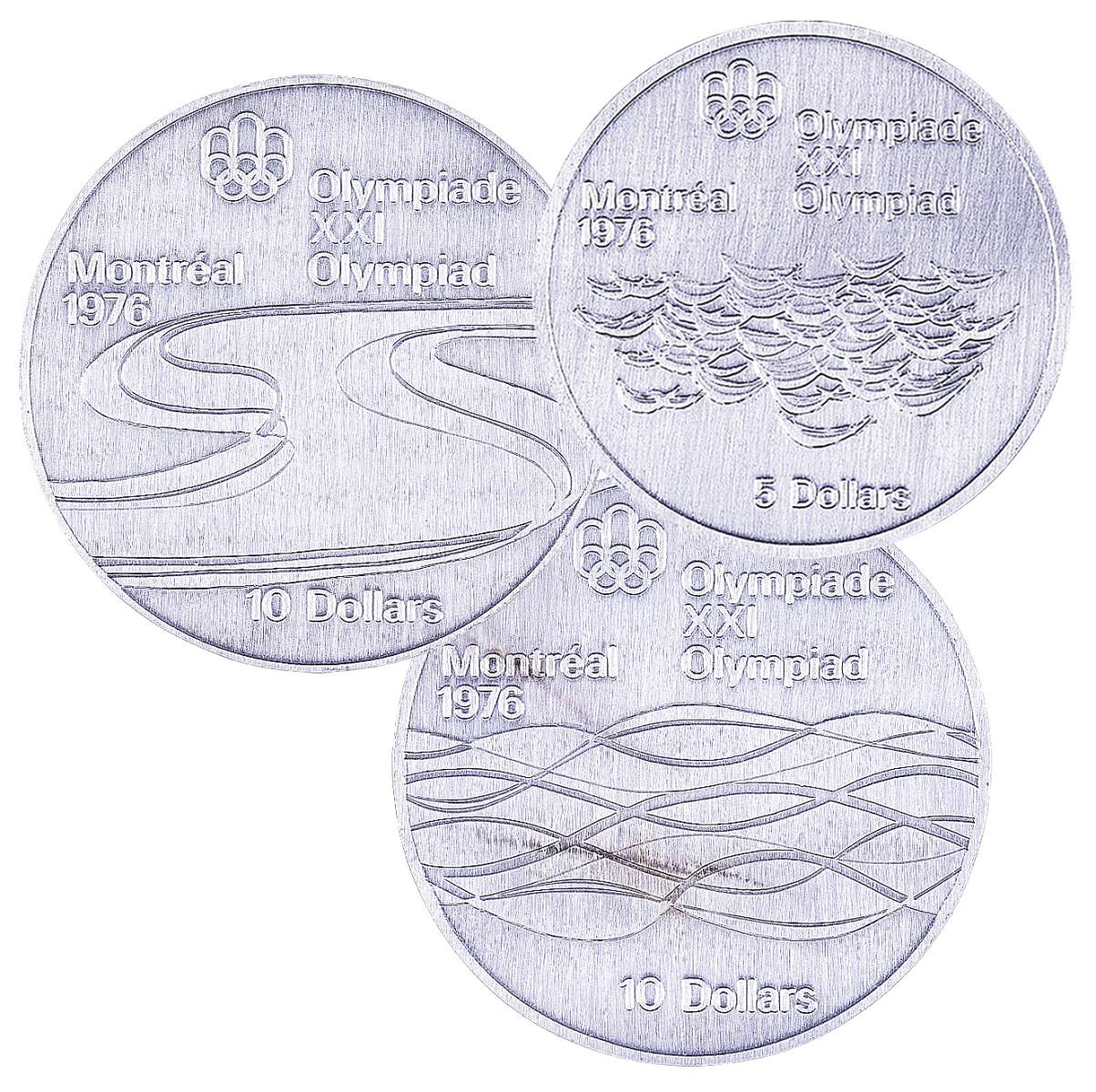
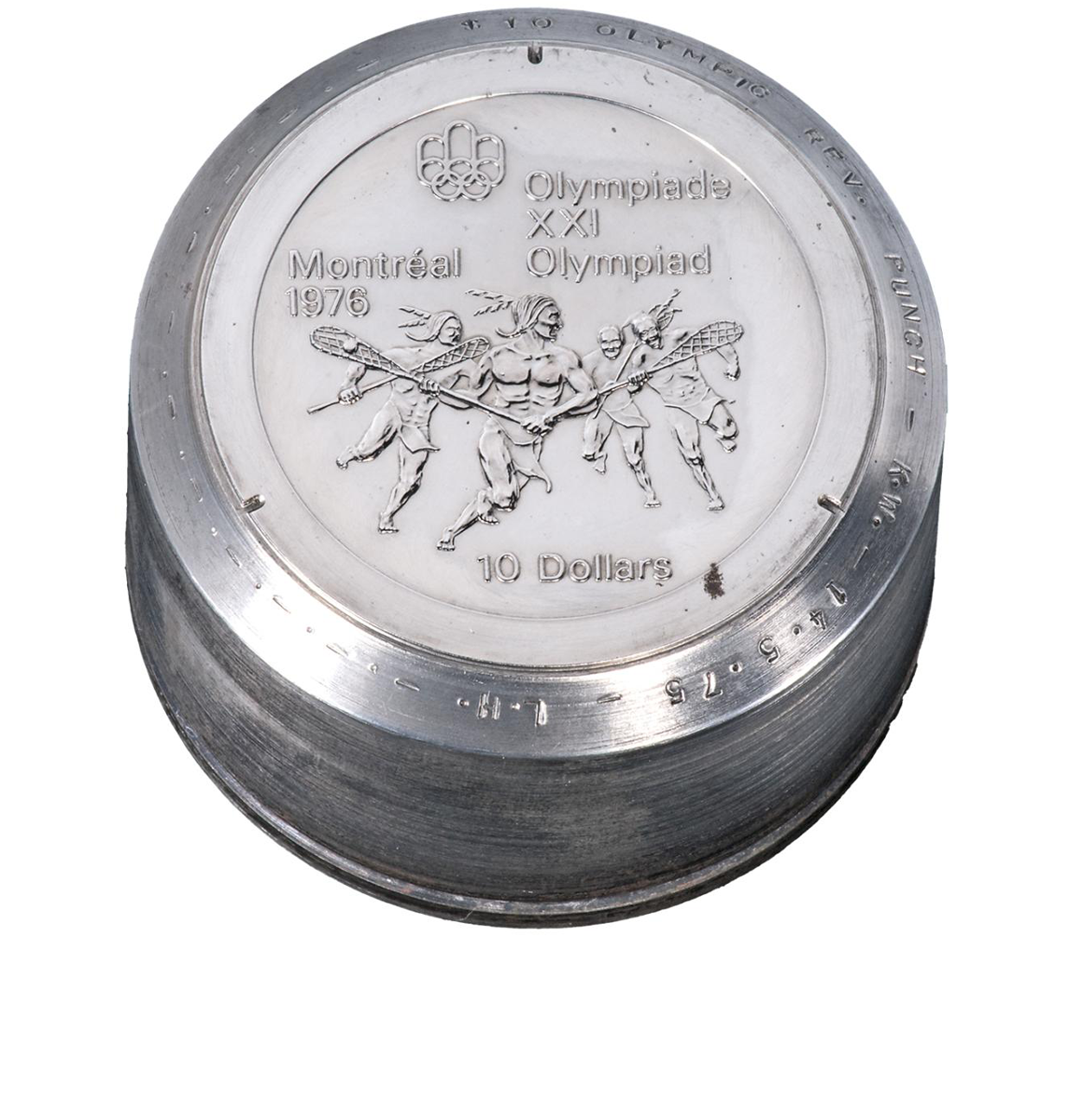
The Bank of Canada Museum recently acquired some Olympic coin patterns engraved from Lynda Cooper’s original designs. The coins were from the estate of Derek Dawson, Director of Products and Logistics for the Olympic Coin Program, that sold at auction in 2019.
Source: Royal Canadian Mint, 5 and 10 dollars, pattern coins, 1975 | 2026.21.1-3
An unexpected outcome
As much as Cooper was surprised to learn that she had won the competition, her participation was unexpected. She recently shared with Bank of Canada Museum staff that a friend working at the Hamilton Spectator had written to the Olympic Coin Program on her behalf to request a design submission package.
Cooper had no interest in participating, but her friend encouraged her to submit designs. That friend went on to become her husband, now of nearly 50 years, and her career as an artist was firmly established.
After I submitted my designs, I completely forgot about the competition, and never expected to hear anything back. But in the spring of 1975, I was still living with my parents. I received a 9 a.m. phone call from Ottawa in which a man informed me that I had won the Olympic coin competition. I was so shocked and surprised I didn’t know how to respond…. My mother was present when I received the call. When I got off the phone and told her my good news, she started screaming “My first born! My first born!” and running around the kitchen, she was so excited. Her commotion woke up my father who had been working the night shift at the Ford plant in St. Thomas – but he wasn’t annoyed.
Lynda Cooper
Her original drawings for the water sports series captured the essence of flowing lines that attracted the judges to her designs. On the advice of members involved in the Olympic Coin Program, Cooper revised her drawings to add human figures into the flowing lines. She also worked with the engravers at the Royal Canadian Mint who helped her translate her designs into a workable model for minting coins.
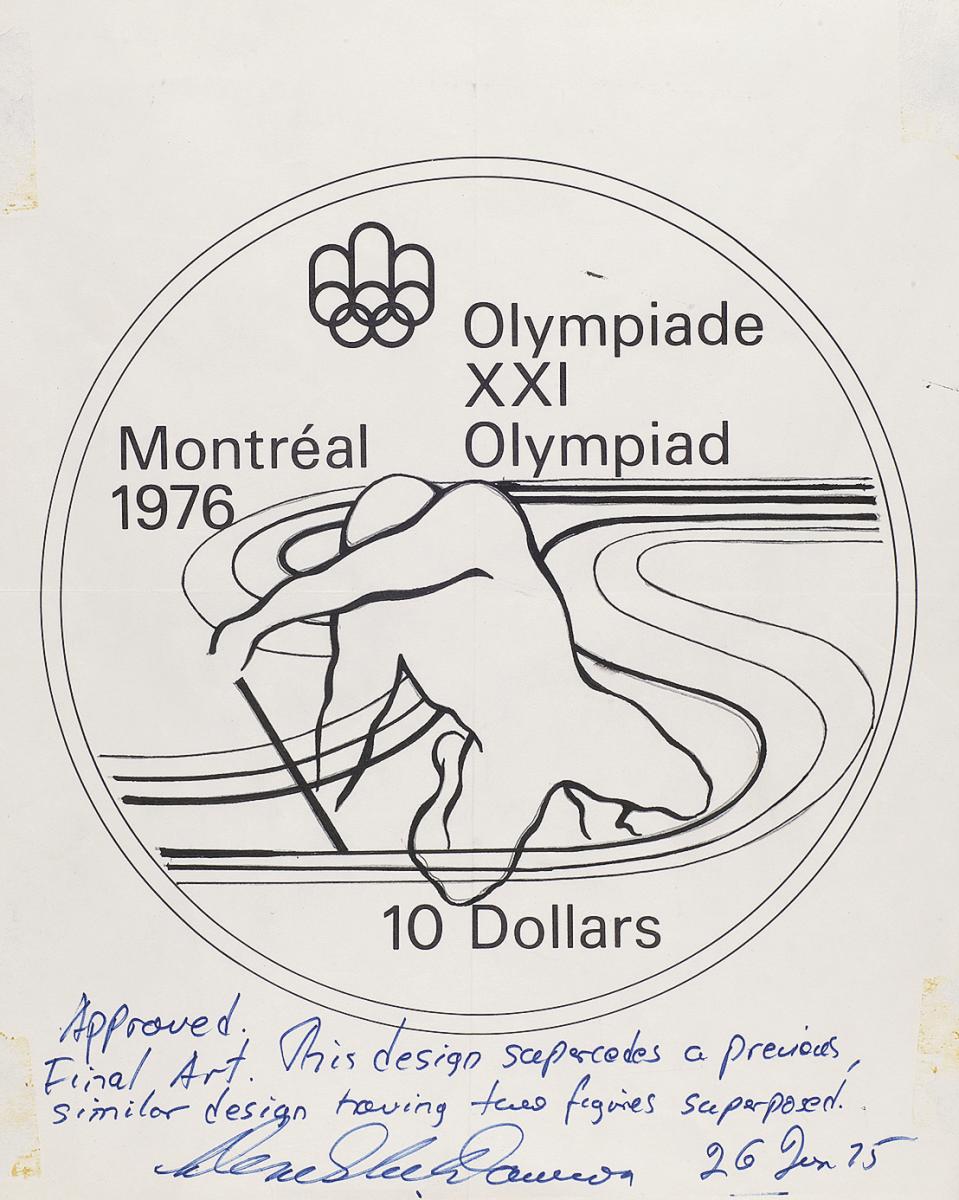
Lynda Cooper was asked to modify her original submissions to add a human figure to all her designs. The outline of a paddler complemented the flowing lines representing a meandering river.
Source: Coin model, Lynda Cooper, 1975, Royal Canadian Mint collection | 1978.65.90
After extensive discussions and design iterations, the final designs were released to the public, and the Royal Canadian Mint went to work, preparing the dies and minting the coins in time for the release of Series 5 on December 1, 1975.
Swept up in the excitement surrounding the Montréal Games, Cooper occasionally took part in promotional events for the Olympic coins. Perhaps her most memorable occasion was her appearance on The Mike Douglas Show, a famous American daytime talk show filmed in Philadelphia and broadcast across North America. Appearing alongside the great track-and-field athlete, Jesse Owens, Cooper presented to the host a set of the coins she had designed. In her own words, “I was speechless and Jesse did most of the talking. But it was a moment that I will never forget!”
Reflecting on the design competition’s impact on her career, Ms. Cooper shares:
The coin competition opened many doors for an unknown art student, that resulted in a full-time job with the Hamilton Spectator starting in 1976. I was commissioned to do other design work, and some of my artwork which was featured in galleries was acquired by collectors. My name was placed on a list of artists routinely invited to participate in future coin and medal design competitions. This resulted in a runner-up prize for the Commonwealth Games in Winnipeg, and first prize in the design for the Conway Medal. I continued working in the art department of the Spectator until 1982, and thereafter I opened my own freelance art service. This led to my artwork appearing in a wide range of international publications….
Lynda Cooper

A recent image of Lynda Cooper, accomplished artist and coin designer.
Source: Lynda Cooper, 2026
Win #4 (or Loss #1?): Aftermath of the Olympic Games and the Olympic Coin Program
As the July 17, 1976 opening ceremonies of the Montréal Games approached, construction costs continued to balloon. In 1970, when Montréal had been announced as the host city, initial estimates to fund the games were $120 million. By 1976, costs had risen to $1.6 billion. In 2006, when the debt to host the Games was finally paid off, a total of $2.7 billion had been spent.
Expectations for funding the Games had been as ambitious as the construction projects. The Olympic Coin Program and a similar initiative with stamps were expected to generate $250 million in profit—more than double the projected cost of the Games. Despite the anticipation and popularity of the first series of $5 and $10 Olympic commemorative coins, public and collector interest in the Olympic Coin Program waned as the Games approached. In the end, the actual profits fell far short of the ambitious expectations.
It was also expected that 63 million coins would be minted, totalling $450 million in face value. In reality, $278.7 million in face value of coins were sold at $388 million: a net profit of $109.3 million. The exact breakdown of the numbers was not immediately known, but the report COJO issued after the Games in 1978 cited the total profit of the coin and stamp programs at $115 million. This included over $50 million from the sale of the gold coins alone. The sale of the silver collector coins fell short of their mark with a total mintage of 13,410,723 $5 coins and 12,270,011 $10 coins, according to the Royal Canadian Mint annual reports from (1973 to 1976). The total face value of silver coins issued for the Montréal Olympics was $189,753,725.
Expensive outcome but fond memories
In the years following the Games, the Olympic coins did not maintain their popularity in the numismatic market. For many years, both the silver and gold coins were trading for their bullion value, which was below their face value. Most banks refused to accept the coins at their face value. With the recent rise in the bullion markets, the Olympic coins have only now finally increased in value.
Yet despite the dwindling coin valuations, cost overruns and soaring debt load, the 1976 Montréal Olympics remain a fond memory for the City of Montréal, for the international athletes who participated, for the crowds that attended, for the performers who took part in the opening and closing ceremonies, and for artists like Lynda Cooper, whose designs were immortalized on Canada’s first real collector coin program.
Content type(s):
Blog posts
We want to hear from you! Do you have an idea for a blog post you’d like to see?
The Museum Blog
The Money of Bytown
Bytown was a frontier town built on the construction of the Rideau Canal and a booming lumber industry. Access to different forms of money and banking facilities provided the liquidity necessary for the town to prosper into Canada’s capital.
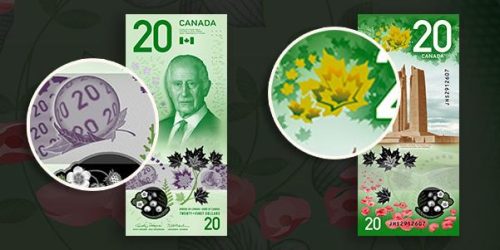
Teaching with the Vertical $20
Engage students with creative activities linking the new bank note to careers, civics, history, social studies and art.
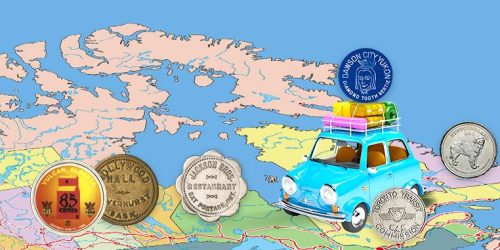
A summer road trip of Canadian tokens
We took a virtual road trip through nearly every Canadian province and territory via trade and souvenir tokens.