The glimmerings of a Canadian identity begin to appear in these bank notes, produced only two years after the First series was issued. The death of King George V, quickly followed by the abdication of his son, Edward VIII, prompted some quick redesigns, but the Bank of Canada took this opportunity to make some very formative changes.
After the First series was issued, the government made a big change to the Bank of Canada Act: all future bank notes were to be bilingual. This was 30 years before the Official Languages Act was passed and prompted bitter debate in the House of Commons. This one change would make bank note production and distribution far simpler. But it required a partial redesign of the notes.
The portrait of King George VI was used on all denominations in this series except for the $100 and $1,000 notes, which featured former Canadian prime ministers. The portraits were moved to the centre, which made a symmetrical design appropriate to bilingual wording. The designs were now more uniform across the series, and each denomination had a new, distinct colour—a familiar colour scheme that, with variations, has since appeared on all our note series. The rear views of the notes remained fundamentally the same as those in the 1935 series, with a few vignettes moving from one denomination to another.
Security features were the same as for the 1935 series. Intaglio printing—raised ink that could be felt—was used extensively on both sides, and green dots called planchettes were scattered throughout the paper.
Explore each note
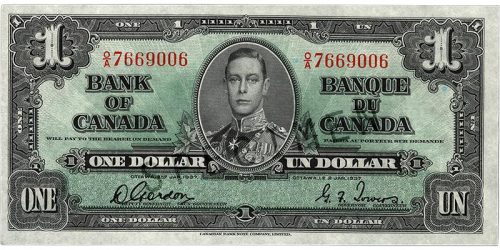
Bilingual Series $1 Note
Like most of this series, this note carries a portrait of King George VI that was previously used in the $50 bill of the First series. The vignette on the back has an agricultural theme that also appeared on the First series $1 note.
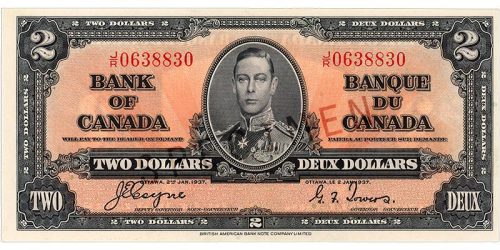
Bilingual Series $2 Note
This note carries a portrait of King George VI that was previously used on the $50 bill of the First series. The back vignette is themed on the harvest, also used on the First series $10.
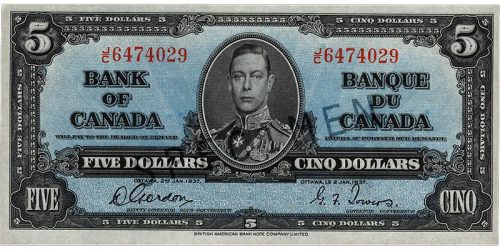
Bilingual Series $5 Note
This note carries a portrait of King George VI that was previously used on the $50 bill of the First series. The back of the note is an allegory for electric power.
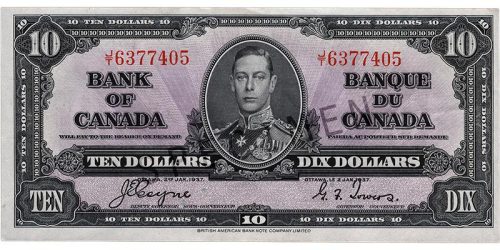
Bilingual Series $10 Note
This note carries a portrait of King George VI that was previously used on the $50 bill of the First series. The back is an allegory representing modern transportation.
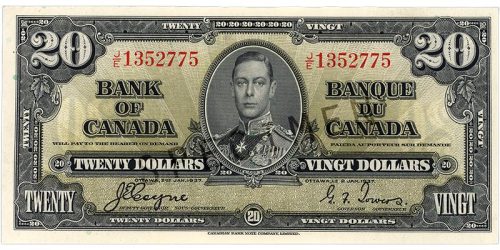
Bilingual Series $20 Note
This note carries a portrait of King George VI that was previously used on the $50 bill of the First series. The back is an agricultural allegory representing fertility.
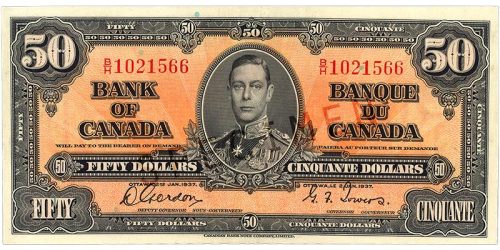
Bilingual Series $50 Note
This note carries a portrait of King George VI that was previously used on the $50 bill of the First series. The back has an allegory of radio and modern inventions.
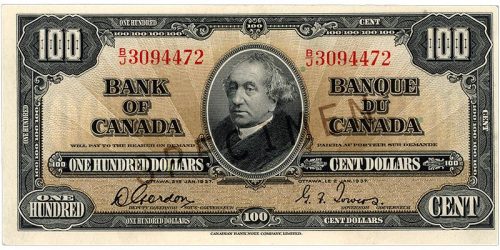
Bilingual Series $100 Note
This note features an engraving of Canada’s first prime minister, Sir John A. Macdonald, previously seen on the $500 note of the First series. The back vignette is an allegory of industry, which also appeared in the $100 note of 1935.
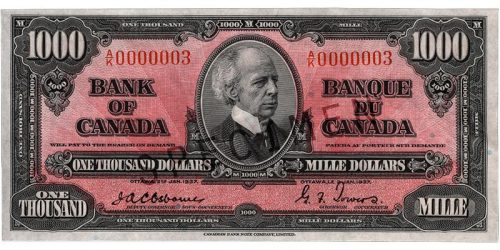
Bilingual Series $1,000 Note
The $1,000 note was printed at the same time as the rest of the series but wasn’t circulated for several years. It has a portrait of Sir Wilfrid Laurier on the face and an allegory of protection on the back.