One of Canada’s most comprehensive resources on Canadian numismatics is now available online.
For decades, numismatists and researchers from all over Canada visited the library of the Bank of Canada Museum in Ottawa to consult the Bowman Encyclopedia. Today, the monumental 29-volume set is available online.
Fred Bowman the engineer
In “Volume 16: Coin Collectors” of the Encyclopedia of Canadian Coins, Tokens and Medals (familiarly known as the Bowman Encyclopedia), Fred Bowman introduced many Canadian collectors and numismatists. He also included a simple autobiography. Fred Bowman was born in Berlin (Kitchener today), Ontario in 1889. He studied civil engineering at the University of Toronto. Shortly after graduation in 1911, Bowman joined the Dominion Bridge Company in Lachine, Quebec, where he worked until his retirement in 1960. Bowman was an officer in the Canadian Expeditionary Force attached to the 7th Battalion Canadian Railway Troops and saw active service during the First World War. During the Second World War, he worked at United Shipyards (Montréal) to supervise the construction of cargo and invasion vessels. Yet Bowman was most recognized for his work as a bridge erection engineer. Over his career, he was involved in the construction of 50 steel structure bridges worldwide.
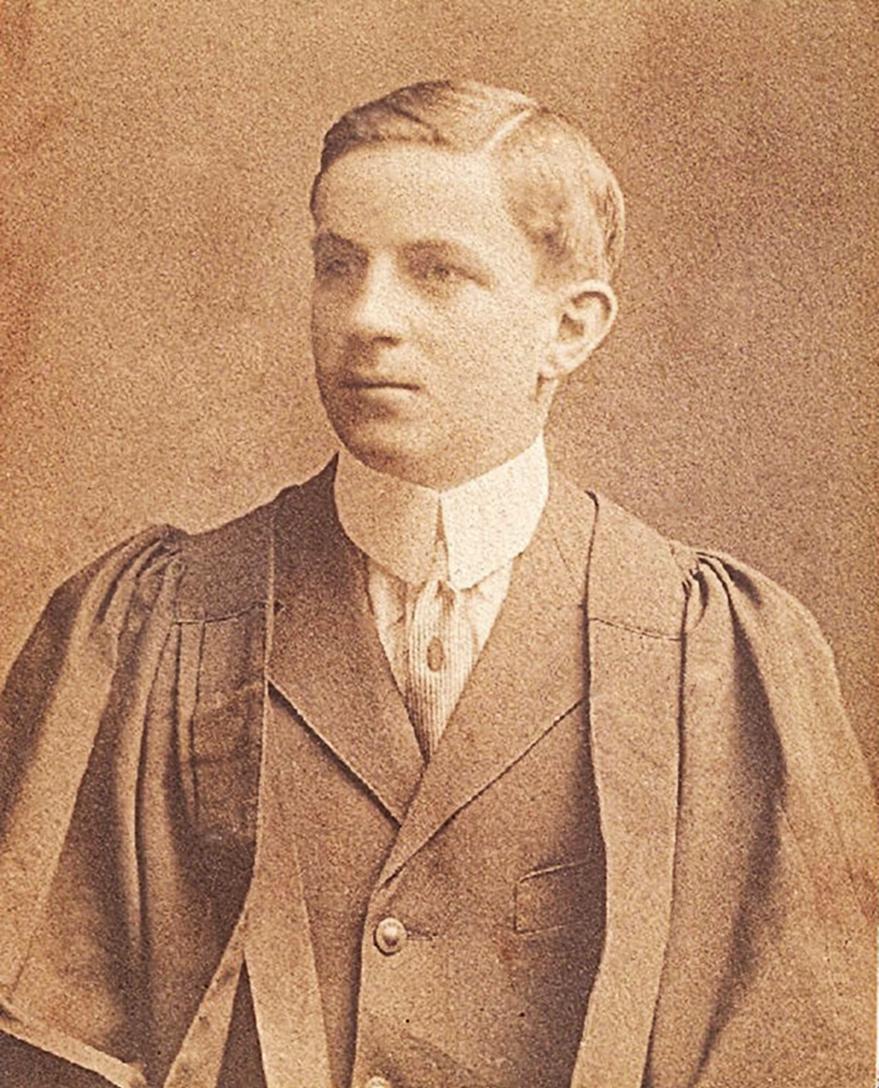
Portrait of a young Fred Bowman. He favoured his left profile because he lost his right eye in an injury when he was nine years old.
Source: Wurm-Hastings.com
Fred Bowman the numismatist
Beyond his illustrious career as an engineer building bridges, Fred Bowman was a distinguished and well-respected numismatist. He was a collector of Canadian coins, tokens and medals and wrote extensively on these topics for several prominent numismatic journals. Mr. Bowman belonged to several numismatic organizations and held important positions in the Montreal Coin Club and the Royal Canadian Numismatic Association. Furthermore, after his retirement from the Dominion Bridge Company, he became the numismatic curator of the prestigious Montreal Antiquarian and Numismatic Society collection at the Château Ramezay Museum in Montréal, a position he held well into his 70s. But Mr. Bowman’s most notable impact on the numismatic community was the creation of his unique manuscript encyclopedia.
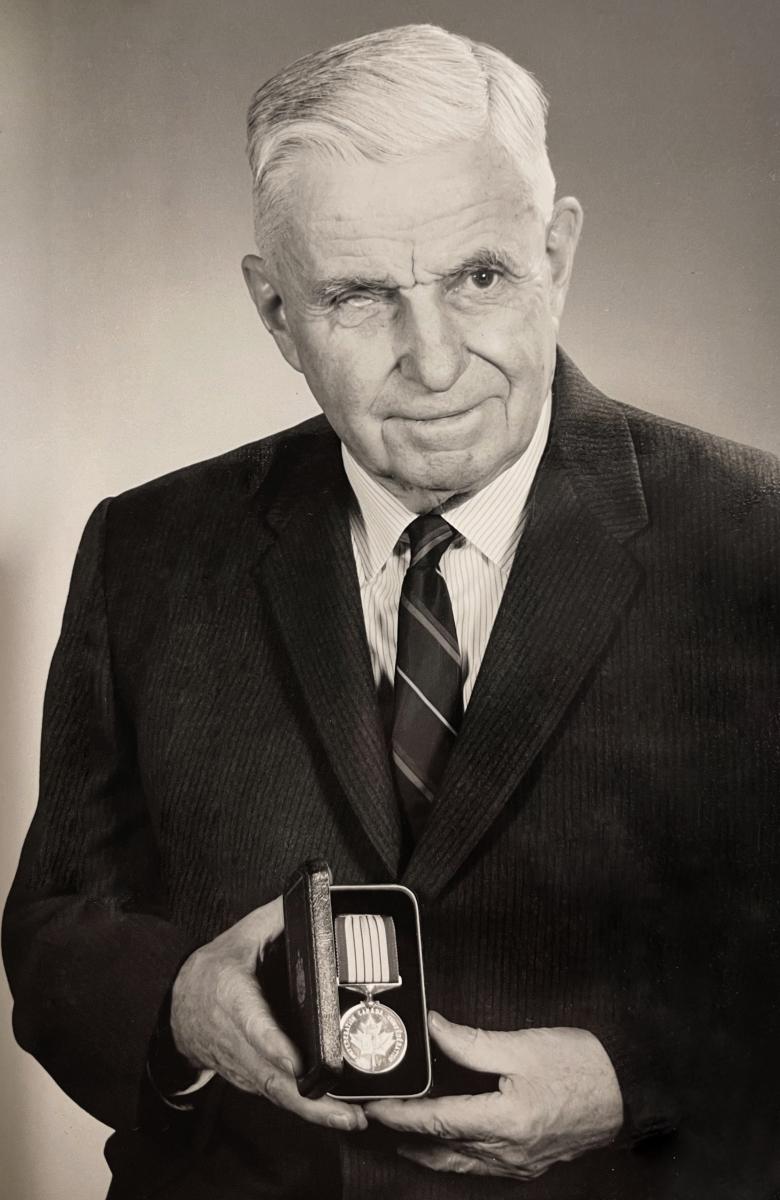
Fred Bowman was a distinguished and honoured numismatist. In 1969, he won the prestigious J. Douglas Ferguson award for his life-long dedication to the support and promotion of numismatics in Canada.
Source: Bowman Encyclopedia, Bank of Canada Museum.
Inside the Bowman Encyclopedia
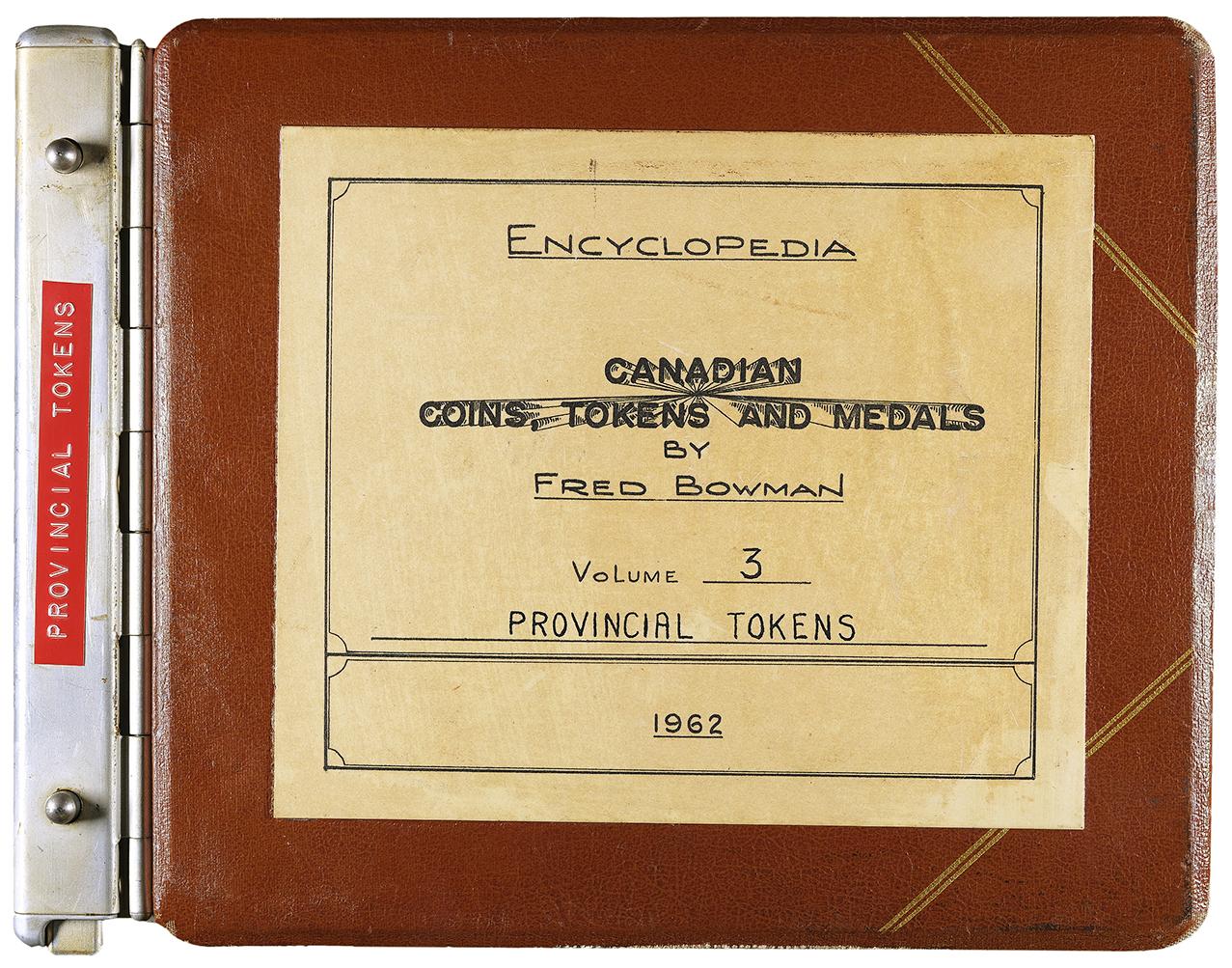
The Encyclopedia of Canadian Coins, Tokens and Medals is the compilation of Mr. Bowman’s decades-long research into Canadian numismatics. Although the encyclopedia is dated 1962, he began work on the catalogue after the Second World War and continued until his death in 1978. The encyclopedia consists of 29 volumes, each one covering a numismatic theme. The themes include colonial, provincial and national coins and tokens as well as commercial tokens of:
- various trades including bakeries and dairies
- services such as transportation and amusement
- religious and sports organizations
- social and fraternal clubs
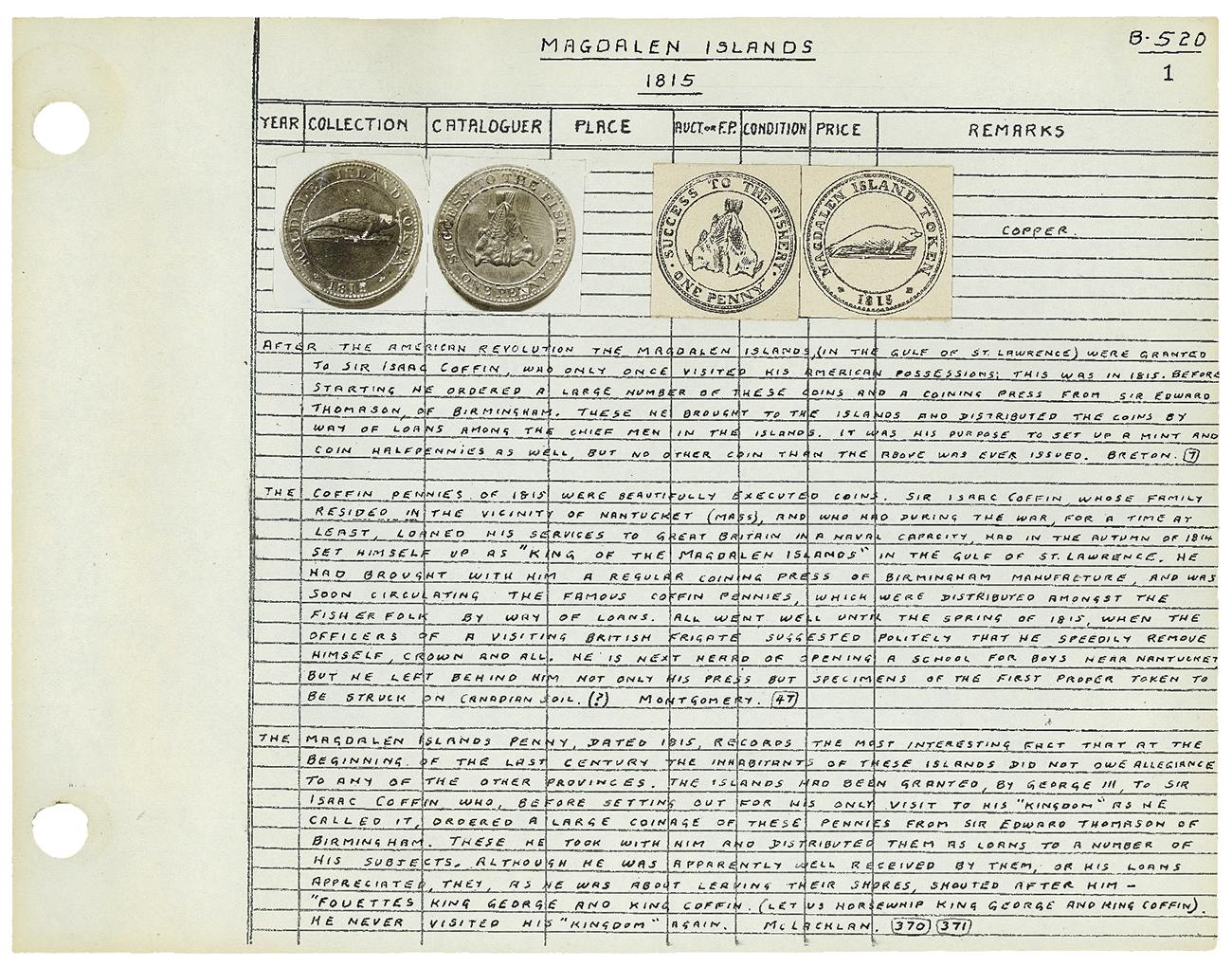
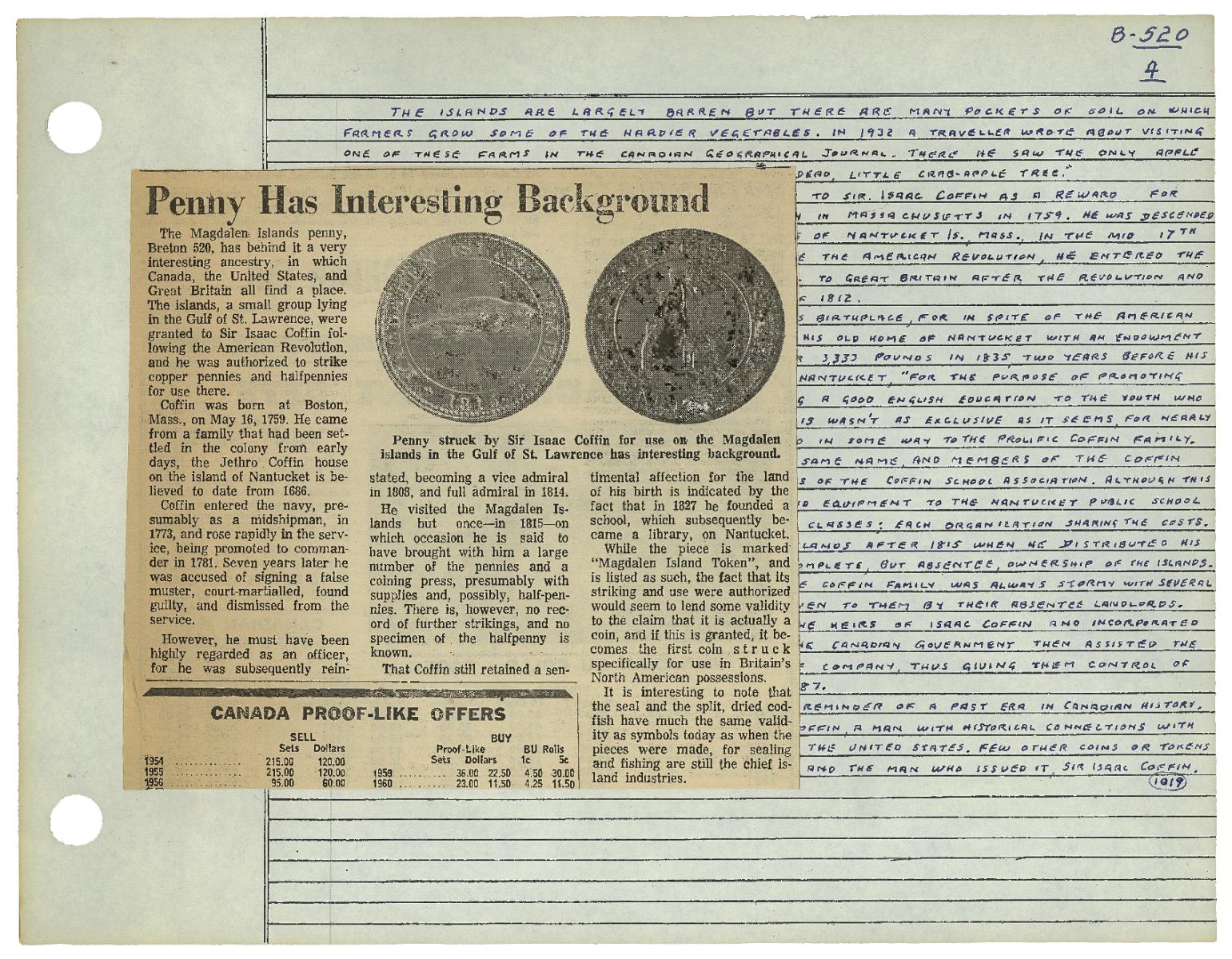
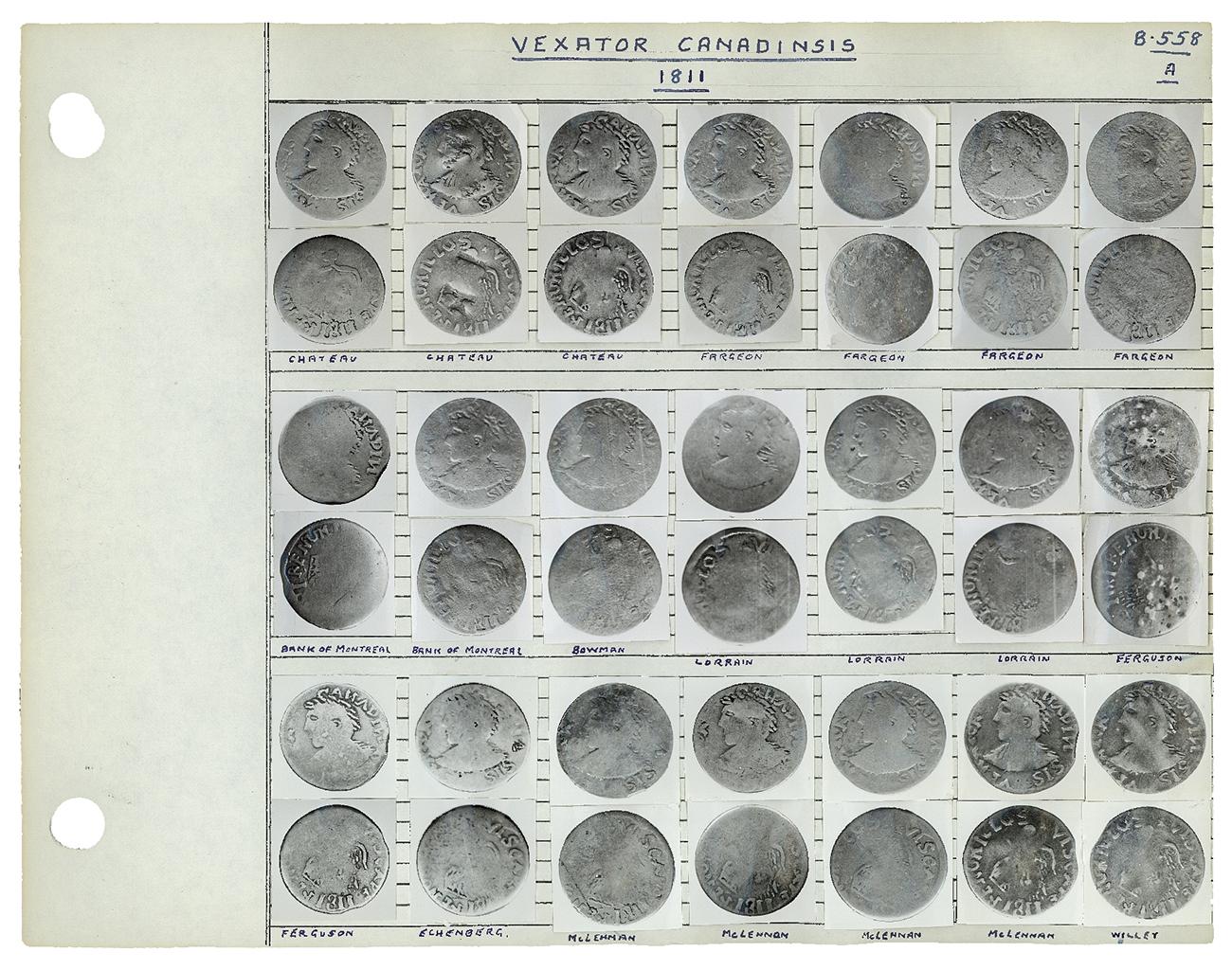
Some volumes are devoted to military decorations, and to commemorative and royalty medals. An entire volume documents the biographies of several Canadian numismatists, and there is a bibliography and a location index. The volumes are a compendium of all the types of numismatic items that Bowman encountered during his long career. Each item contains a brief write-up, along with a catalogue of past transactions concerning the piece and a provenance of many of the scarcer pieces.
Before Fred Bowman’s passing in 1978, the Bank of Canada acquired the Bowman Encyclopedia and has maintained its pristine condition by carefully storing it among the Museum’s collection of rare books in a climate-controlled environment. The encyclopedia is a very important reference for numismatic researchers, and while it has always been available for consultation, this had to be done on-site at the Bank of Canada in Ottawa. Now, the encyclopedia volumes are available in PDF format on the Museum’s website.
Not only is the Bowman Encyclopedia an important resource for numismatists and researchers, but the assembly and presentation of the volumes themselves are a testament to an engineer’s touch and skill. Each volume consists of loose-leaf pages with a printed table format template that Bowman drafted himself. He painstakingly wrote information by hand and attached images and support documents, such as newspaper clippings and articles, to many pages. He then assembled pages into a volume bound on two metal pins whose lengths vary depending on the thickness of the volume. Finally, he bound the pages with two rigid covers, front and back, manufactured by Dawson Brothers, Stationers of Montréal. Just looking at the volumes is a treat! But flipping through the pages opens the reader to a whole wealth of information that, for the most part, has never been seen by many numismatists. Until now. The entire content of the Bowman Encyclopedia, which represents more than 16,000 pages, is available free for anyone to consult.
Digitizing the Museum’s unique archival holdings
The digitization of the Bowman Encyclopedia is the beginning of our efforts to make available some of the Museum’s unique archival material. This material compliments the development of the National Currency Collection. Upcoming projects include digitizing:
- the professional notes of Major Sheldon Carroll, the first curator of the National Currency Collection
- the archival holdings and correspondence of J. Douglas Ferguson
- the original correspondence of several prominent Canadian numismatists, including R.W. McLachlan and F.X. Paquet
Beyond the 130,000 artifacts in the National Currency Collection, the Museum’s numismatic library and archives are a treasure that is critical to developing our collective numismatic knowledge. Making it available online will certainly help!
Content type(s):
Blog posts
We want to hear from you! Do you have an idea for a blog post you’d like to see?
The Museum Blog
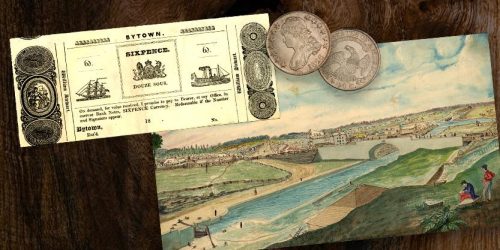
The Money of Bytown
Bytown was a frontier town built on the construction of the Rideau Canal and a booming lumber industry. Access to different forms of money and banking facilities provided the liquidity necessary for the town to prosper into Canada’s capital.
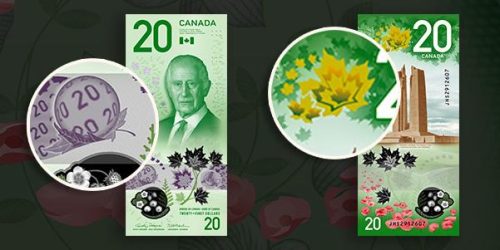
Teaching with the Vertical $20
Engage students with creative activities linking the new bank note to careers, civics, history, social studies and art.
A summer road trip of Canadian tokens
We took a virtual road trip through nearly every Canadian province and territory via trade and souvenir tokens.