An act of Parliament in 1934 gave the Bank of Canada the exclusive responsibility to issue Canada’s bank notes. At that time, commercial banks also had the right to issue bank notes, but that right was phased out over the following decade.
The Bank officially opened for business on March 11, 1935. On the same day, it issued its first bank note series. It was really two issues because French and English versions of every denomination were produced—the only time this would occur.
The Bank’s first notes were designed by two security printing companies working with the federal government: the British American Bank Note Company and the Canadian Bank Note Company. Even for 1935, the notes weren’t modern in appearance but very much of a nineteenth-century aesthetic. The numbers, rosettes, frames and some of the vignettes were straight out of the security printers’ catalogues. It was the only series to feature royalty other than the reigning monarch. Seven members of King George V’s family appeared across the denominations. Prime ministers appeared on the two highest denomination notes—which are also the least commonly used. The words “Ottawa, Issue of 1935” appeared on all the notes.
On the reverse sides were allegorical figures symbolizing Canada's growing agricultural, industrial and commercial prosperity. The security features of the day included intricate fine-line patterns; easily felt raised ink; and small, randomly scattered green dots called planchettes. The $500 note was unique to this series, as was the $25, a commemorative note for the King’s silver jubilee—marking 25 years on the throne.
Explore each note
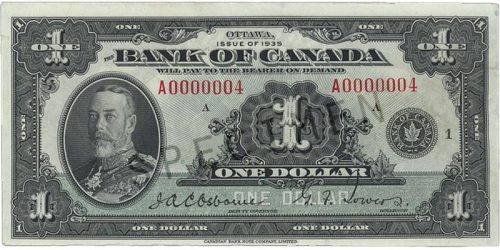
First Series $1 Note
The First series $1 featured King George V, who reigned from 1910 to 1936. The vignette on the back of the note represents agriculture.
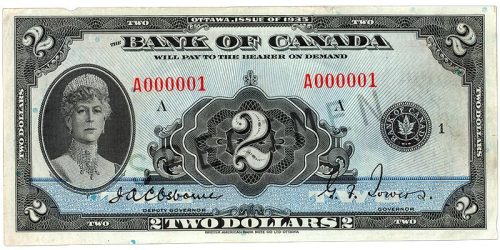
First Series $2 Note
Queen Mary, wife of King George V, graces the face of this note with an allegorical image on the back representing modern transportation.
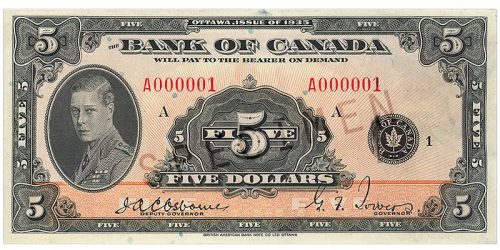
First Series $5 Note
This note features a portrait of Edward, Prince of Wales, the first son of King George V and Queen Mary. The back of the note is an allegory for electric power.
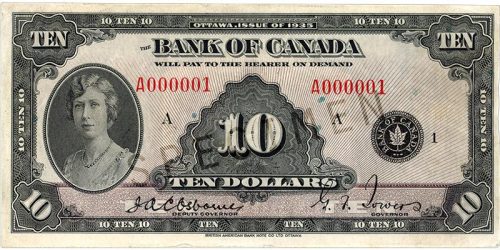
First Series $10 Note
The First series $10 note shows Princess Mary, only daughter of King George V and Queen Mary. On the reverse is an image of harvest.
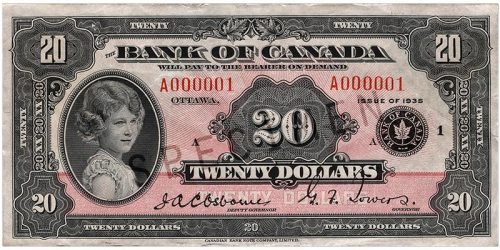
First Series $20 Note
On this note is an engraving of eight-year-old Princess Elizabeth, future Queen Elizabeth II. She was the granddaughter of King George V and Queen Mary and third in line to the throne at this time. The back vignette is a harvest allegory called “Testing the Grain.”
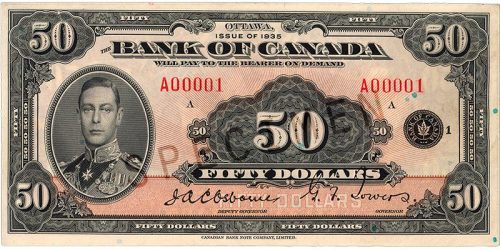
First Series $50 Note
The $50 note carries a portrait of Prince Albert, Duke of York, second son of King George V and Queen Mary. He was the future King George VI. The back vignette is the allegory “Radio.”
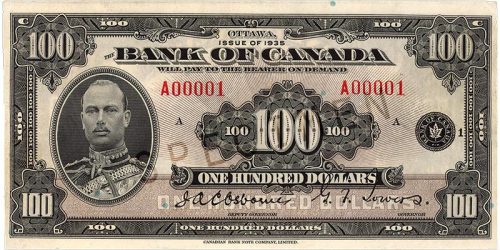
First Series $100 Note
The $100 note carries a portrait of Prince Henry, Duke of Gloucester, third son of King George V and Queen Mary. The vignette on the back is an allegory of industry.
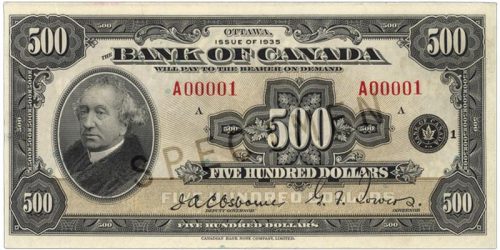
First Series $500 Note
This was the only $500 note issued by the Bank of Canada. It is one of two notes in the series carrying Canadian prime minister, in this case it is Sir John A. Macdonald. The vignette on the back is a harvest allegory representing fertility.
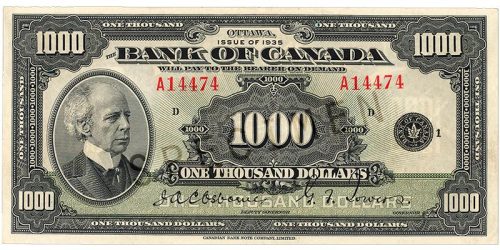
First Series $1,000 Note
Canada’s seventh Prime Minister and first Francophone Prime Minister, Sir Wilfrid Laurier, is on the face of this note. An allegorical image of security and protection is on the back.
Commemorative notes
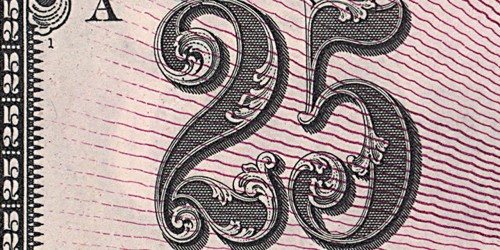
First Series $25 Commemorative Note
This unique note commemorated the 25th anniversary of the reign of King George V and Queen Mary. Windsor Castle on the back of the note is the only image from outside Canada used on Canadian government money.