In the late 1970s, technology was about to catch up to security printers in the form of accurate colour printing processes and, more worryingly, colour photocopiers. So, before it had even issued all of the Scenes of Canada notes, the Bank of Canada began exploring new approaches to security printing.
The Birds of Canada series is considered transitional, as far as security features are concerned. The series kept the more traditional features of previous series but also included a feature beyond the paper and printing processes: a reflective patch. The patch shifted colour when the note was tilted, but to a scanner, it would appear as just one dark colour. This is one of the first bank note series anywhere to include such an optical security device.
The designers decided on an open, simple look that would make the imperfections of new technologies used by counterfeiters more easily detected. The word “Canada,” in the sky behind the birds, appeared tinted but was in fact full of microprinted parallel lines. When digitally scanned, twisted patterns and horizontal lines appeared in what seemed a tinted, blank space. This is an optical illusion called a moiré pattern, which cannot be seen when looking at a real note. Birds were chosen not only as clear and simple subjects, but for their beauty, popularity and political neutrality. This was also the first series to address accessibility. Colours were made bolder, denominations enlarged, and each note could be identified by a hand-held, audio device.
This was also the series that bid farewell to the $1,000 bill, the $2 bill and traditional guilloche patterns (as seen in the big numbers on the front).
Security
How to check notes
If you are unsure about a note from an older series, ask for a more recent one.
1. Metallic patch
Tilt the note. The patch changes from gold to green. Touch the patch. There are no detectable raised edges and it cannot be peeled off.
Note: the $2, $5 and $10 notes of this series do not have a metallic patch.
2. Raised ink
Feel the raised ink on the large number, the shoulders of the portrait, and the two horizontal bars that run the length of the note.
3. Green dots
Look at the small green dots that appear at random on both sides of the note. If they are on the surface, they can be scratched off.
Explore each note
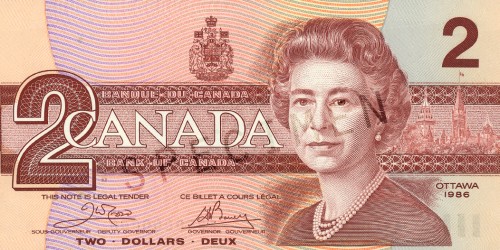
Birds of Canada Series $2 Note
Issued in September 1986 and printed by both Canadian Bank Note Company Ltd. and British American Bank Note Company, the $2 note was the second in the new series and features a portrait of the Queen engraved by Henry S. Doubtfire of De La Rue, based on a photograph by Dennis Constantine.
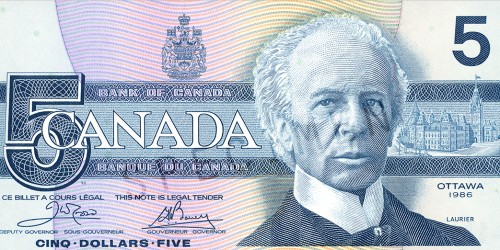
Birds of Canada Series $5 Note
The face of the $5 note features a portrait of Sir Wilfrid Laurier engraved by Yves Baril. Beside the portrait is the Centre Block of the Parliament Buildings as it appeared in Laurier’s day.
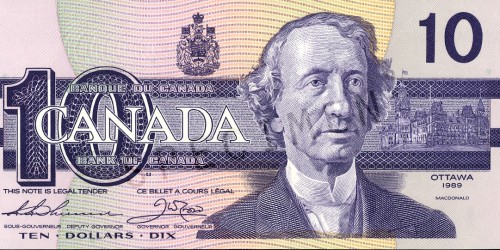
Birds of Canada Series $10 Note
Printed by British American Bank Note Company and issued in June 1989, the $10 note features a portrait of Sir John A. Macdonald engraved by Thomas Hipschen of the U.S. Bureau of Engraving and Printing.
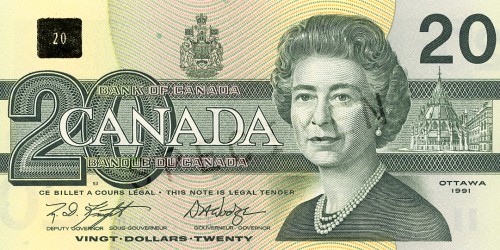
Birds of Canada Series $20 Note
The face of the $20 note features the Doubtfire engraving of the Queen that appears on the $2 note, but the adjacent vignette spotlights the Library of Parliament.
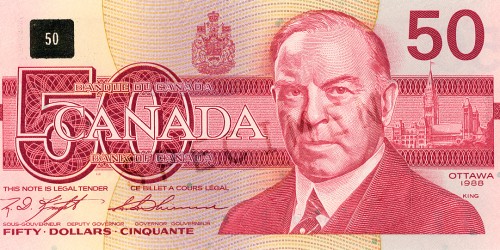
Birds of Canada Series $50 Note
The $50 note issued in December 1989 was the first in the series to carry the cutting edge optical security device on its face.
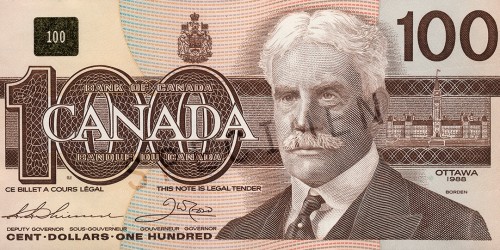
Birds of Canada Series $100 Note
The second note to feature the optical security device was the $100 note, printed by British American Bank Note Company issued in December 1990.
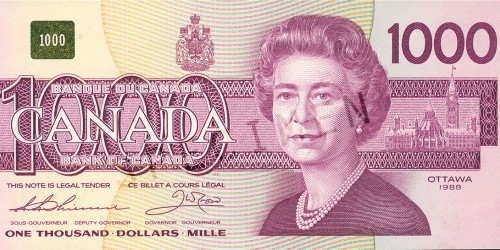
Birds of Canada Series $1000 Note
The note’s face features the Queen’s portrait. On her left is a view of the Parliament Buildings, showing the north side of the Centre Block with the Library of Parliament in the foreground.